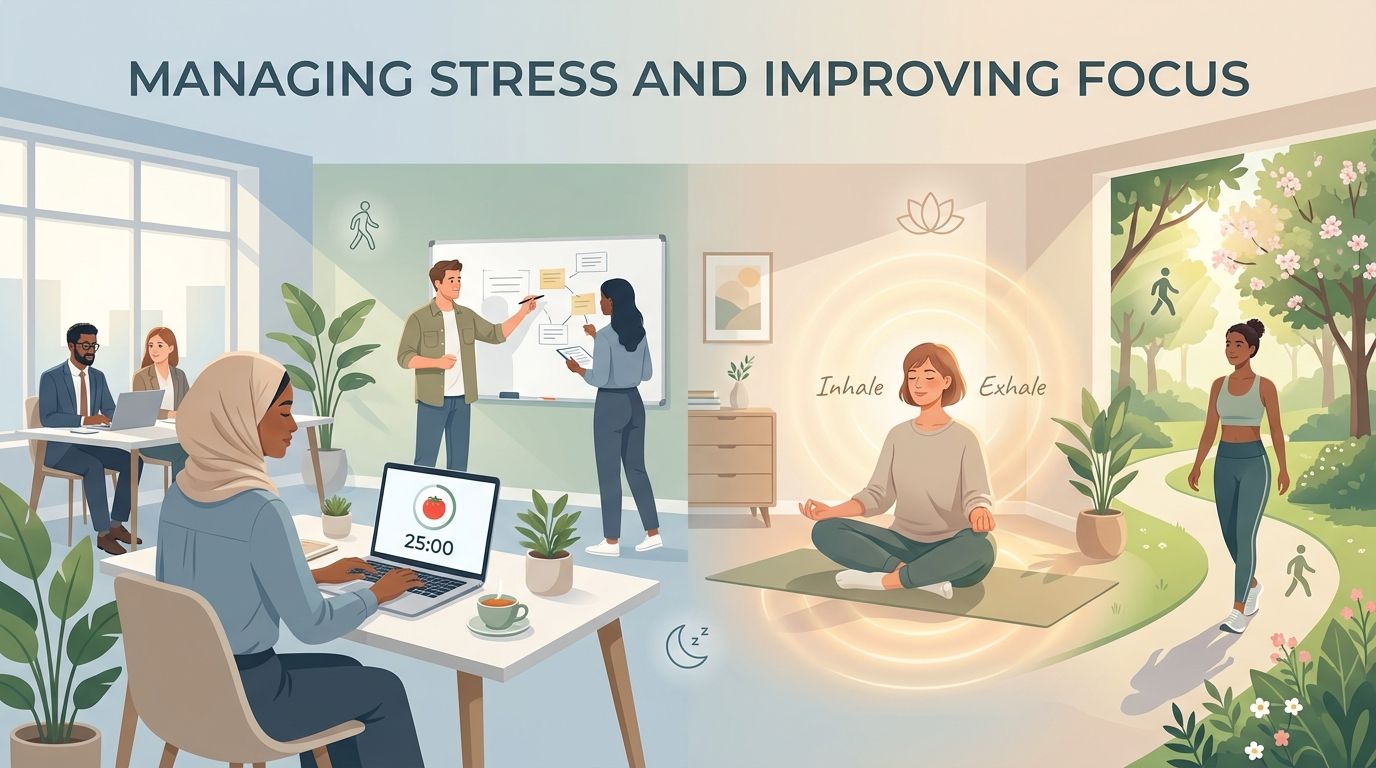
Managing stress and maintaining sharp focus are essential skills for professionals, students and anyone balancing a hectic schedule. In this guide you’ll discover habit-based, practical methods to manage stress and increase concentration—starting with simple daily routines and scaling up to deeper lifestyle changes.
Why learning to manage stress matters
Stress undermines cognitive performance, decision-making, and long-term health. When you learn to manage stress effectively, you protect your mental energy, improve memory and attention, and create consistent productivity. Research links chronic stress to reduced prefrontal cortex function (which governs focus) and increased emotional reactivity. For reliable overviews, see the American Psychological Association (APA – Stress) and Harvard Health (Harvard Health – Relaxation Techniques).
Core principles: Habits, environment and energy
- Habits beat willpower: small, consistent routines are more sustainable than one-time pushes.
- Design your environment: reduce distractions and make healthy choices easier.
- Manage energy, not just time: align high-focus work with peak energy windows.
Daily habit framework to manage stress and boost focus
Below is a repeatable daily framework with practical micro-habits you can adopt immediately. Each step is short, evidence-informed, and designed for busy people.
1. Morning reset (5–20 minutes)
- Hydrate and light exposure: Drink water first thing and get 5–10 minutes of natural light to regulate circadian rhythm.
- Brief movement: A 5-minute mobility or light exercise routine raises alertness and reduces stress hormones.
- Focused intention: Spend 2–3 minutes on a simple breathing exercise or a three-item priority list for the day—this primes the brain for focus.
2. Anchor with micro-practices during work/study
- Pomodoro technique: Work in focused blocks (e.g., 25–50 minutes) followed by 5–10 minute breaks. This structure reduces cognitive fatigue and helps you sustain concentration.
- Microbreaks: Every hour, stand, stretch, or do a 60-second breathing pattern (inhale 4s, hold 4s, exhale 6s) to reduce physiological stress.
- Single-tasking: Use a visual cue (closed door, headphones) to signal deep work and avoid task switching.
3. Midday reset and nutrition
- Balanced meals: Prioritize protein, healthy fats and complex carbs to stabilize blood sugar and sustain focus.
- Movement break: A 10–20 minute walk after lunch reduces stress and improves post-meal alertness.
- Limit caffeine later in the day: To protect sleep and cognitive recovery.
4. Evening wind-down
- Technology boundary: Stop screens 60–90 minutes before bed or use blue light filters and a calming routine.
- Reflection: Spend 5 minutes journaling wins and unfinished tasks—this offloads worry and helps you disconnect.
- Sleep hygiene: Prioritize 7–9 hours, consistent schedule, and a dark, cool bedroom to restore attention capacity.
Evidence-based techniques to reduce stress
Mindfulness and breathing practices
Mindfulness reduces rumination and improves working memory. Short, daily sessions (5–15 minutes) of focused breathing or body scan produce measurable benefits over weeks. Pair mindfulness with breathwork—box breathing or coherent breathing—to lower heart rate and reduce cortisol. See research summaries at the National Institutes of Health (NIH – Mindfulness).
Cognitive reframing and acceptance
Reappraising stressors and practicing acceptance decreases emotional reactivity. Use simple CBT-based prompts: “What evidence supports this worry?” or “Is this thought actionable right now?” These quick checks prevent escalation of stress and preserve focus.
Physical activity and movement
Regular exercise is one of the strongest protectors against stress and attention decline. Aim for at least 150 minutes of moderate aerobic activity per week, plus strength training twice weekly. Even short, high-intensity bursts during the day improve mood and concentration.
Productivity systems that reduce stress
Time blocking and task batching
Time blocking reserves chunks in your calendar for focused work; task batching groups similar tasks (emails, calls, admin) to reduce context switching. Together they lower cognitive load and create predictable rhythms that reduce daily stress.
Weekly review and planning
Schedule a weekly 20–30 minute review to clarify priorities, clear small tasks, and plan focus blocks for the week. This habit shrinks mental clutter and reduces reactive stress.
Designing a low-distraction environment
- Digital hygiene: Turn off non-essential notifications, use focus modes, and keep messaging apps closed during deep work.
- Workspace cues: Maintain a clutter-free desk, good lighting, and a comfortable chair to support longer, focused sessions.
- Signal transitions: Use rituals (a short playlist, a cup of tea) to mark the beginning and end of focused intervals.
Practical tools and apps
- Focus timers: Forest, Pomodone, or Toggl Track to schedule deep work blocks.
- Mindfulness apps: Headspace, Calm, or Insight Timer for guided practices.
- Task systems: Todoist, Notion, or Microsoft To Do for simple task capture and weekly planning.
Choose 1–2 tools and make them part of the routine—tools should support habits, not replace them.
Sample daily plan: A realistic routine for busy people
Below is a concise schedule that integrates the techniques above. Customize times for your life.
- 06:30 — Wake up, hydrate, 5-minute sunlight exposure
- 06:40 — 10-minute mobility + 3-minute breathing
- 07:00 — Breakfast high in protein
- 09:00 — Deep work block (90 minutes), Pomodoro if preferred
- 11:00 — Short break, movement
- 13:00 — Lunch + 15-minute walk
- 14:00 — Focused tasks or meetings (batched)
- 16:30 — Microbreak + breathing
- 18:30 — Wind-down, review top priorities for tomorrow
- 21:30 — Screens off, light reading or relaxation
When to seek professional help
If stress becomes overwhelming, persistent, or starts affecting sleep, relationships, or job performance, consult a mental health professional. Therapy, coaching, and in some cases medical support, can provide tailored strategies beyond self-help techniques. Trusted resources include the World Health Organization and local health services.
Measuring progress and staying consistent
Track small signals of improvement: longer focus intervals, quicker recovery after interruptions, reduced worry at night. Use a simple habit tracker or a weekly note—consistency beats intensity. Celebrate micro-wins to maintain momentum.
Suggested external links
- APA on stress (https://www.apa.org/topics/stress)
- NIH on mindfulness (https://pmc.ncbi.nlm.nih.gov/…)
- Harvard Health on relaxation (https://www.health.harvard.edu/…)
Quick checklist to start today
- Identify your top 3 priorities for tomorrow tonight.
- Add one 5-minute breathing practice to your morning.
- Schedule two 90-minute deep work blocks this week.
- Take a 10-minute walk after lunch every day for one week.
- Turn off non-essential notifications for focused work.
Closing thoughts
Learning to manage stress and improve focus is a process that combines small habits, intentional environment design, and consistent recovery. Start with one manageable change and build from there—the compound effect of small improvements will support sustained productivity and well-being. If you want a printable habit checklist or a weekly planner template, check the internal resources linked above for guided, step-by-step sets tailored to professionals and students.