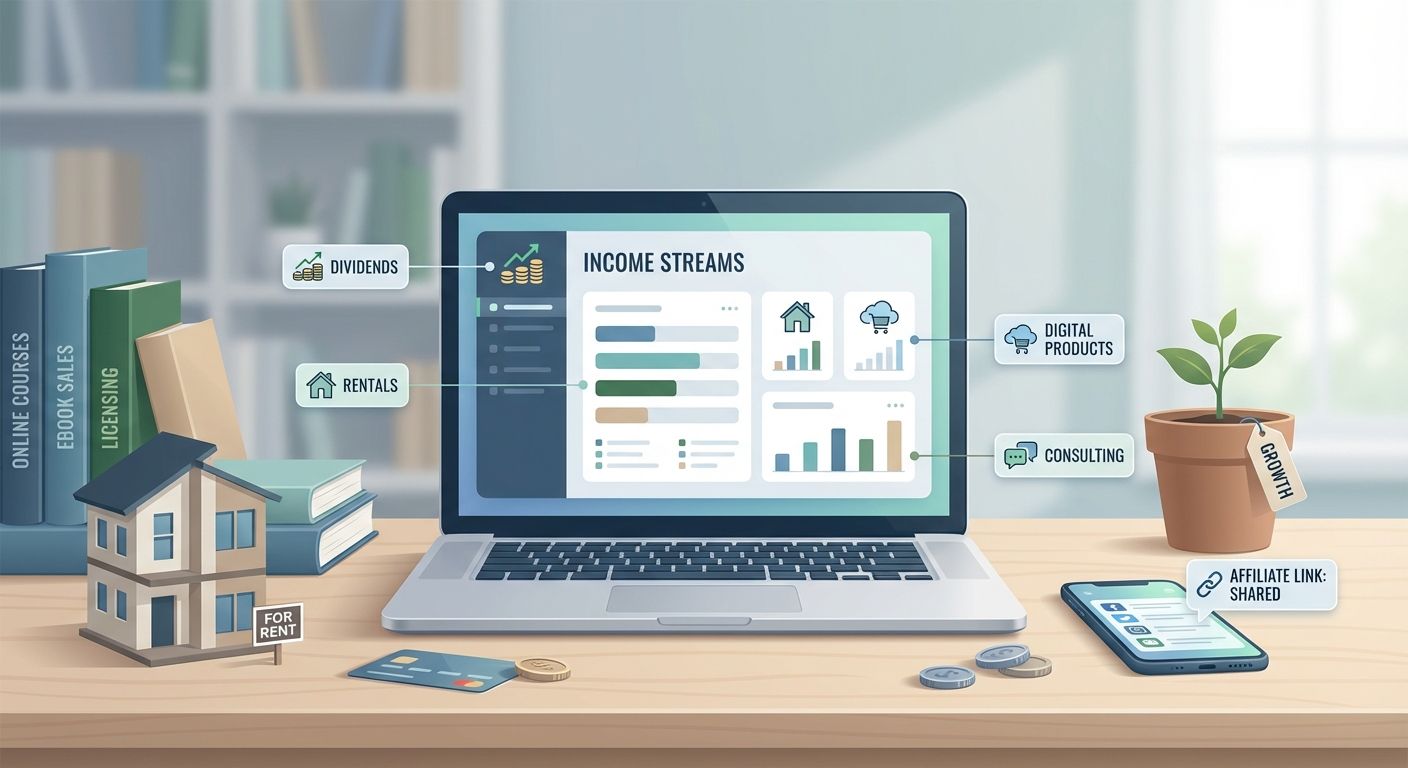
Multiple income streams are a central strategy for anyone who wants to reduce financial risk, increase cash flow and move faster toward financial independence. This guide shows practical, accessible methods you can start implementing now — whether you are a professional, entrepreneur, or beginner investor.
Why You Need Multiple Income Streams
Relying on a single paycheck increases vulnerability to job loss, industry shifts, or economic downturns. By creating multiple sources of income, you spread risk and open new pathways to wealth. Diversification helps with:
- Income stability: Layered revenue reduces the impact of any one source dropping.
- Faster wealth accumulation: Additional cash flow accelerates saving and reinvesting.
- Flexibility: More choices about work, hours and projects.
- Resilience: Protection against market shifts and career changes.
Types of Income: Active, Passive and Hybrid
Understanding income categories helps you choose strategies that fit your life and time horizon.
Active Income
Income earned by trading time for money: salaries, consulting, freelancing, and contract work. Active income is reliable but limited by hours available.
Passive Income
Income that requires upfront effort or capital but then generates cash flow with minimal ongoing input: dividends, rental income, royalties, digital products, and affiliate revenue.
Hybrid Income
Models that start active and become passive over time: online courses, SaaS, membership sites, or a niche business that can be automated or delegated.
Practical Strategies to Create Multiple Income Streams
Below are practical, accessible strategies categorized by effort and capital needed. Each item includes key steps, benefits and realistic timelines.
1. Freelancing & Consulting (Low-to-Medium Capital; Quick Start)
Turn professional skills into paid projects. Ideal for professionals and entrepreneurs.
- Steps: Define a service, set pricing, build a one-page portfolio, list services on platforms (Upwork, Fiverr, LinkedIn).
- Advantages: Fast cash flow, high control, scalable by raising rates or hiring subcontractors.
- Timeline: Weeks to months to establish steady clients.
2. Side Businesses & E-commerce (Medium Capital; Scalable)
Launch an online store, dropshipping, print-on-demand, or sell niche products. Use platforms like Shopify, Etsy, or Amazon.
- Steps: Validate product demand, set up store, optimize product listings, run low-cost ads and organic marketing.
- Advantages: High upside, repeatable sales, potential to automate processes.
- Timeline: 3–9 months to scale; dependent on marketing and product-market fit.
3. Digital Products & Online Courses (Low Capital; High Leverage)
Create ebooks, templates, or online courses that sell repeatedly after an initial build.
- Steps: Identify a problem you can solve, create structured content, host on Teachable/Podia/Skillshare, promote via email and social media.
- Advantages: High margin, passive once live, builds authority.
- Timeline: 1–6 months to create; ongoing marketing required.
4. Rental Real Estate & Short-Term Rentals (Medium-to-High Capital)
Owning property generates rental cash flow and potential appreciation. Consider long-term leases or short-term rentals (Airbnb).
- Steps: Secure financing, choose cash-flow-positive properties, manage or outsource property management.
- Advantages: Scalable, tax benefits, inflation hedge.
- Timeline: Months to acquire; steady cash flow after occupancy.
Learn more about rental investing: Investopedia guide to rental properties.
5. Dividend Stocks, ETFs & Bonds (Low-to-Medium Capital; Passive)
Investments that pay periodic returns: dividends and interest. Use diversified ETFs to reduce single-stock risk.
- Steps: Open a brokerage account, set an investment plan (DCA), prioritize low-cost index funds or dividend aristocrats.
- Advantages: Passive income, liquidity, compounding over time.
- Timeline: Months to years for meaningful income; reinvest dividends to accelerate growth.
6. Peer-to-Peer Lending & Credit Platforms (Medium Risk)
Platforms like LendingClub or Prosper let you earn interest by lending to borrowers. This can generate higher yields but carries credit risk.
7. Royalties & Intellectual Property (Low Ongoing Effort; Variable Capital)
Write a book, license photography, create music, or patent an invention. Royalties are a true form of passive income when successful.
8. Affiliate Marketing & Niche Content Sites (Low Capital; Passive over time)
Publish targeted content and monetize with affiliate offers or display ads. Focus on high-intent keywords and helpful content.
- Steps: Choose a niche, build a content plan, optimize for SEO, join affiliate programs (Amazon Associates, ShareASale).
- Advantages: Scalable traffic-driven revenue.
- Timeline: 6–18 months for organic traffic to reach meaningful income.
Step-by-Step Roadmap to Build & Scale Multiple Income Streams
Follow a structured process to avoid spreading yourself too thin and to maximize the odds of success.
- Audit your skills, assets and time: List marketable skills, savings available for investment, and hours per week you can commit.
- Prioritize 2–4 complementary streams: Combine one active income (freelancing or consulting) with one or two passive options (digital product, dividend investing, rental).
- Set SMART goals: Specific, Measurable, Achievable, Relevant, Time-bound goals for each stream (e.g., $500/month from freelancing in 3 months).
- Test quickly and cheaply: Use MVPs (minimum viable products) to validate demand before heavy investment.
- Automate and delegate: Outsource repetitive tasks to virtual assistants, use automation tools for email, billing and social scheduling.
- Reinvest profits: Allocate a portion of each stream’s profits back into growth or into higher-yield investments.
- Monitor key metrics: Track cash flow, conversion rates, ROI and time invested for each stream.
Risk Management and Tax Considerations
Creating multiple income streams adds complexity. Protect your downside:
- Legal structure: Use an LLC or corporate entity when appropriate to limit liability and organize taxes.
- Tax planning: Track income by source; consider working with a tax professional to optimize deductions and understand reporting (self-employment taxes, capital gains).
- Emergency fund: Maintain 3–6 months of expenses to handle disruptions.
- Diversification: Avoid overconcentration in one industry or asset class.
For authoritative tax guidance refer to resources such as the U.S. Internal Revenue Service (IRS) and consult a certified accountant in your jurisdiction.
Scaling, Automation and Time Leverage
To make income streams sustainable and less dependent on your time, focus on leverage:
- Productize services: Turn consulting into packaged offerings or group programs.
- Use technology: Automate workflows with Zapier, CRM systems, email marketing and scheduling tools.
- Hire and delegate: Outsource operations to freelancers or agencies when margins support it.
- Build systems: Document standard operating procedures to enable consistent delivery and handoffs.
Practical Examples & Mini Case Studies
Real-world examples help translate concepts into action.
Example 1 — The Mid-Level Professional
Background: A marketing manager with 10 years’ experience.
- Streams built: freelance consulting ($800/mo), online course ($300/mo), dividend portfolio ($150/mo) within 18 months.
- Approach: Leveraged LinkedIn to get consulting clients, repurposed training into a course, and allocated 25% of consulting income into index ETFs.
Example 2 — The Early Entrepreneur
Background: Founder of a small e-commerce store.
- Streams built: ecommerce sales, affiliate content site, short-term Airbnb rental.
- Approach: Outsourced fulfillment, focused content on high-intent keywords to drive organic traffic, used profits to secure a rental property.
Tools, Resources
Recommended tools to implement and scale income streams:
- Automation & Productivity: Zapier, Make, Trello, Notion.
- Marketplaces & Platforms: Upwork, Fiverr, Shopify, Teachable, Airbnb.
- Investing: Vanguard, Fidelity, Robinhood, or your local broker for ETFs and dividend stocks.
Common Mistakes to Avoid
- Spreading too thin: Trying dozens of projects without finishing any. Focus and iterate.
- Ignoring unit economics: Track ROI, not just gross revenue.
- Failing to automate: Manually running everything prevents scale.
- Neglecting taxes and legal structure: Unexpected liabilities can erode profits.
Checklist: First 90 Days Plan
- Complete a skills and asset audit (week 1).
- Choose 2 priority income streams and set SMART goals (week 2).
- Launch MVP for one stream (weeks 3–6).
- Begin a second stream in parallel at lower intensity (weeks 7–12).
- Automate, document and reinvest profits (end of 90 days).
Conclusion
Building multiple income streams is not about chasing every opportunity; it’s a disciplined process of identifying complementary paths that match your skills, time and capital. With a focused roadmap, smart risk management and steady execution, you can reduce dependence on a single paycheck, accelerate wealth creation and gain meaningful financial freedom.
Ready to get started? Choose two streams from this guide, set clear goals, and take the first small step today — test an MVP, list a service, or open an investment account. Small, consistent actions compound into sustainable income and long-term financial independence.
External references used for guidance and best practices include Investopedia and the IRS; always consult a financial or tax professional for personalized advice.