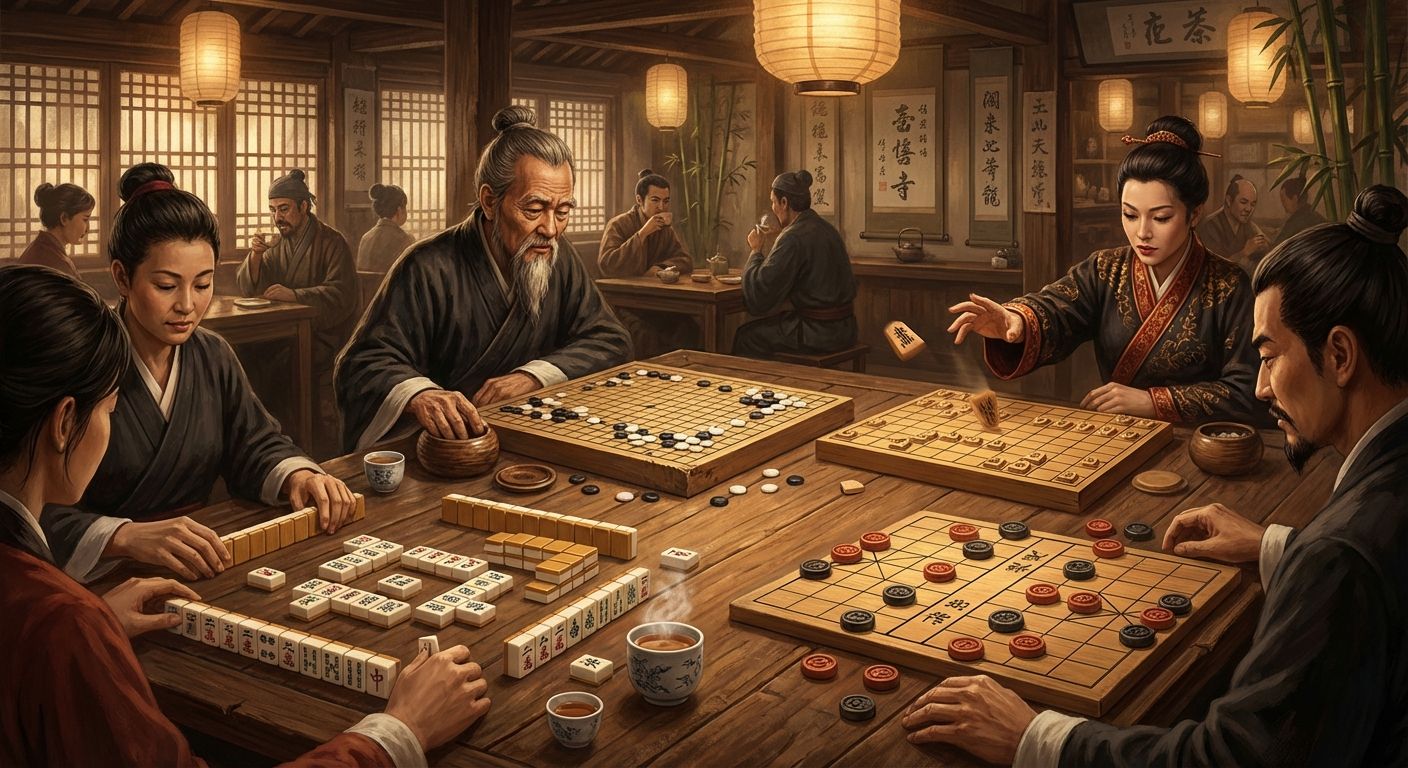
Traditional Asian games have shaped centuries of social life across Asia, blending deep strategic thinking, cultural symbolism, and spirited social rituals. This guide introduces major classics—Go, Shogi, Mahjong, Xiangqi and a few lesser-known but influential games—covering their origins, basic rules, strategy highlights and fascinating curiosities.
Why study traditional Asian games?
Traditional games are windows into history, psychology and culture. They reveal how different societies formalized conflict, learning and leisure. For students, hobbyists and cultural explorers, learning these games sharpens strategic thinking and offers a living connection to centuries of practice.
Overview: common themes and LSI terms
Across Asia, board and tile games emphasize:
– territory and influence (Go)
– piece promotion and capture mechanics (Shogi)
– tile-matching, memory and social scoring (Mahjong)
– military simulation and positional play (Xiangqi)
These titles fall under related search terms you might encounter: Asian strategy games, East Asian board games and classic Asian tabletop games.
1. Go (Weiqi / Baduk)
Origins and cultural role
Go, called Weiqi in Chinese, Baduk in Korean and Go in Japanese, originated in ancient China over 2,500 years ago. Historically associated with scholars and military strategists, Go became one of the four arts of the Chinese scholar-gentleman (the others: calligraphy, painting and music).
Basic rules
Go is played on a grid (typically 19×19) where two players alternately place stones of opposite colors. The primary objectives are:
- Surround territory: Enclose empty intersections to score points.
- Capture: Surround opponent stones with no liberties to remove them from the board.
- Endgame: The game ends by mutual pass; the player with higher territory plus captured stones wins.
Key mechanics include liberties, atari (one-liberty threats), and ko (a rule preventing immediate recapture to avoid infinite loops).
Strategy highlights
- Balance local fights with global influence.
- Value frameworks (moyo) and solid territory differently depending on opponents and board situation.
- Study joseki (corner sequences) and fuseki (opening patterns) while keeping flexibility.
Curiosities
- The world’s oldest recorded Go problems and texts date back to ancient China; the game spread to Korea and Japan over centuries.
- Professional Go culture in Japan and Korea supports rigorous ranks, pro tournaments and lifelong study.
- Go was the first major board game where AI (AlphaGo) made headlines by beating top human players, spotlighting machine learning advances.
2. Shogi (Japanese chess)
Origins and cultural role
Shogi evolved from earlier Indian and Chinese chess variants, reaching a distinctive form in medieval Japan. It has been a staple of Japanese culture, producing professional leagues and famous masters.
Basic rules
Shogi is played on a 9×9 board. Each player has a standardized set of pieces with unique moves, similar to chess but with a critical twist:
- Piece drops: Captured pieces change allegiance and can be reintroduced onto the board by the captor as a move.
- Promotion: Pieces entering or moving within the enemy territory may promote to stronger forms.
Objective: Checkmate the opponent’s king.
Strategy highlights
- Drop mechanics create extraordinary tactical depth—defensive weaknesses can be exploited by well-timed drops.
- Castle your king while preparing attacking formations; piece coordination differs from Western chess.
- Endgames often feature piece returns and perpetual threats due to dropped pieces.
Curiosities
- Shogi players often study opening “castle” formations like Mino and Anaguma.
- Because captured units can be reused, material advantage is less decisive than in chess—initiative and tempo matter immensely.
3. Mahjong
Origins and cultural role
Mahjong originated in 19th-century China and later evolved into many regional variants across East and Southeast Asia, as well as unique American and Japanese versions (e.g., Riichi Mahjong). It is a social game, commonly played in family gatherings, clubs and casinos.
Basic rules (common concepts)
Mahjong is played with a set of 136–144 tiles depending on the variant. Players draw and discard tiles to complete a winning hand composed of melds (sets) and a pair. Common melds include:
- Pong (three identical tiles)
- Chow (three consecutive tiles in the same suit)
- Kong (four identical tiles)
Scoring is variant-dependent; many systems reward complexity, rare combinations and situational bonuses.
Strategy highlights
- Tile efficiency and reading opponents’ discards are crucial.
- Understanding probabilities and adjusting risk vs. reward when pursuing rare hands boosts long-term success.
- In Riichi Mahjong, declared ready hands and defensive play create additional depth.
Curiosities
- Many Mahjong traditions are social: ritualized tea breaks, calling conventions and regional slang.
- Mahjong culture influenced music, film and literature in 20th-century East Asia.
- Riichi Mahjong introduced a rich professional scene in Japan with televised matches and strong online communities.
4. Xiangqi (Chinese chess)
Origins and cultural role
Xiangqi, or Chinese chess, simulates a battlefield with distinct pieces and a central river. It remains one of China’s most popular strategy games for casual and competitive play.
Basic rules
Xiangqi uses a 9×10 grid with pieces placed on intersections. Notable rules include the river (which affects movement for some pieces), the palace (restricting the king/general) and unique movement rules for the cannon (which captures by jumping over a single piece).
Strategy highlights
- Central control and pawn advancement across the river are key themes.
- Cannons and horses provide dynamic tactical opportunities; balancing material and positional threats is essential.
Curiosities
- Many Xiangqi matches historically took place in parks and tea houses, making the game part of everyday culture.
- Variants and regional rule differences exist between mainland China, Vietnam (where a related game called Cờ tướng is played) and overseas communities.
5. Other notable traditional Asian games
- Janggi: The Korean cousin of Xiangqi with subtle rule differences and an open board feel.
- Chaturanga and its descendants: Ancient Indian chaturanga evolved into various regional chess forms, influencing modern chess.
- Pachisi / Ludo relatives: Indian cross-and-circle race games that emphasize chance, negotiation and social play.
- Makruk: Thai chess with a distinct pawn structure and strategic tempo.
How to start learning
Practical steps to begin:
- Choose one game to focus on: Go for long-term strategic study, Mahjong for social play, Shogi for tactical variety.
- Use beginner-friendly resources: online tutorials, apps and rule guides.
- Practice with slow games, review annotated matches and learn common patterns (joseki, openings, standard melds).
Recommended resources and external links:
- Go: Britannica — Go (Weiqi)
- Shogi: Britannica — Shogi
- Mahjong: Britannica — Mahjong
- Xiangqi: Xiangqi — Wikipedia overview
Common beginner mistakes and tips
- Beginners often focus too much on local fights—try to maintain a global perspective, especially in Go and Xiangqi.
- Ignoring drop and promotion mechanics in Shogi leads to tactical blunders; study reintroductions of captured pieces.
- In Mahjong, chasing rare hands too early can be costly; balance efficiency and scoring potential.
Frequently asked questions (FAQ)
Which traditional Asian game is best for beginners?
It depends on your goals. Mahjong offers social, fast-paced entry; Go challenges long-term strategic thinking; Shogi and Xiangqi teach tactics and positional play. Try online tutorials or apps to sample each.
Are there professional scenes and tournaments?
Yes. Go, Shogi and Mahjong (particularly Riichi) have professional players, organized leagues, and major tournaments that are broadcast and studied widely.
Can I learn these games online?
Absolutely. Many platforms offer new-player lessons, AI opponents and reviewed games. Seek communities for feedback: forums, club meetups and streaming channels are excellent.
Conclusion
Traditional Asian games are more than pastimes—they are cultural artifacts that encapsulate centuries of thinking, competition and social bonding. Whether you’re drawn to the territorial depth of Go, the tactical fireworks of Shogi, the social dynamics of Mahjong, or the battlefield feel of Xiangqi, each game offers a rich path for learning and enjoyment. Start small, study patiently and join communities where culture and strategy meet.
Further reading and exploration can expand your understanding: consult historical articles, join local clubs, or try online play. These games reward persistence and curiosity—both staples of meaningful cultural study.