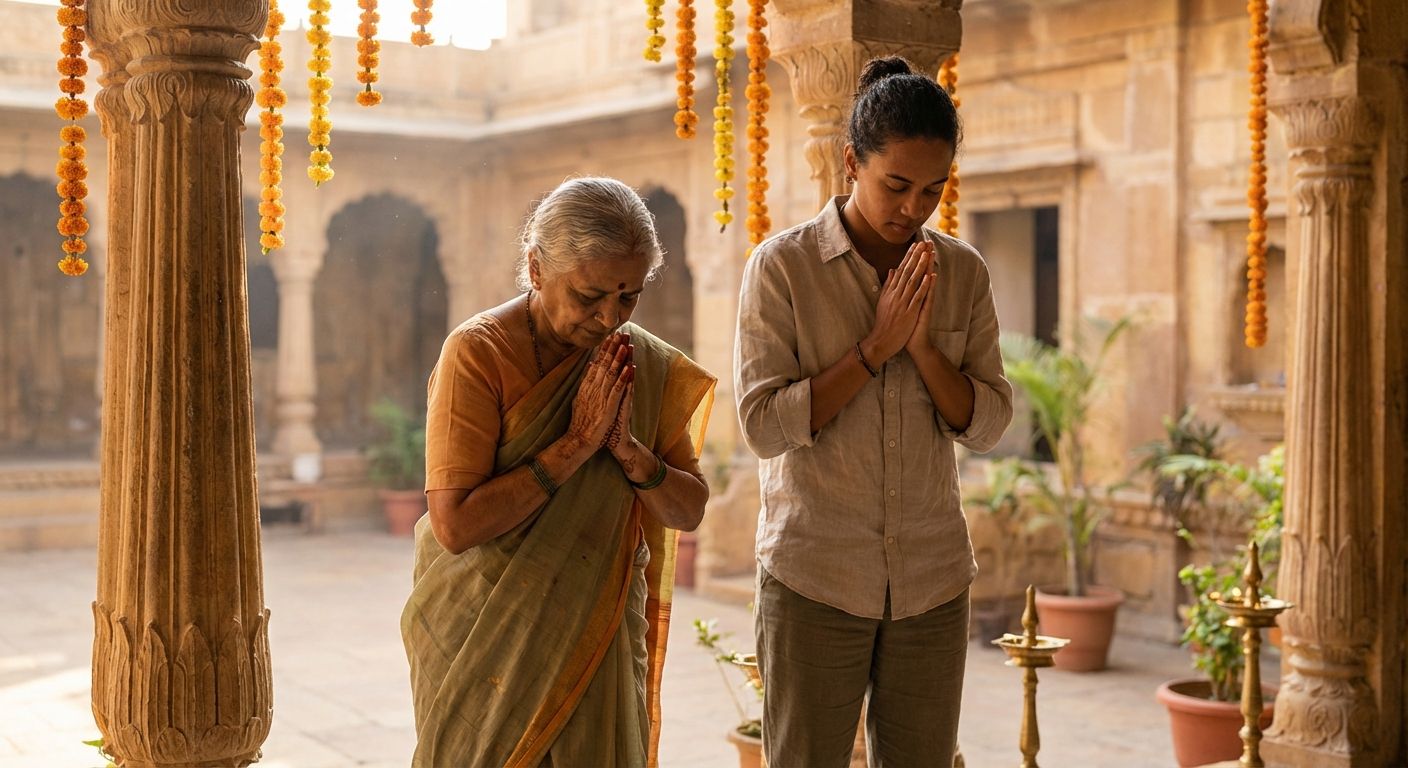
The meaning of “Namaste” goes beyond a simple greeting, reflecting a rich cultural expression rooted in Sanskrit, Hindu rituals, and social traditions.
What Does Namaste Mean?
The term Namaste originates from the Sanskrit compound nāma (to bow) + te (to you), and is commonly translated as “I bow to you” or “I honor the divine in you.” In India, it is used in daily greetings, formal introductions, and religious ceremonies. While often reduced in the West to a yoga-room salutation, the word carries centuries of cultural, spiritual and philosophical significance.
Etymology and Historical Roots
Etymology: The word derives from Sanskrit — namas meaning “bow, obeisance, adoration,” and te meaning “to you.” Classical Sanskrit texts and later devotional literature use forms of namas frequently in prayers and salutations.
Early Literary and Religious Usage
In Vedic and classical Hindu traditions, gestures of reverence and verbal salutations are central. Texts such as the Mahabharata and various Puranas and devotional hymns include salutations that reflect respect, surrender, or recognition of the sacred. Over time, the phrase crystallized into the single-word salutation we now call Namaste, often accompanied by a gesture — the hands pressed together at the chest (Anjali Mudra) and a slight bow.
Verbal and Gesture Components: How Namaste Is Performed
There are two primary components:
- Verbal — saying “Namaste” or regional variations (e.g., “Namaskar,” “Namaskaram,” “Pranam”).
- Physical — the Anjali Mudra: palms pressed together in front of the heart, fingers pointing upward, often combined with a slight bow of the head.
This combination signals respect, humility, and recognition. In many families and communities the gesture precedes or replaces handshakes and embraces.
Cultural Contexts and Social Meanings
Understanding the cultural meaning of Namaste requires seeing how it functions across different contexts:
Everyday Social Greeting
In India, Namaste is a polite, non-contact greeting appropriate for most settings: meeting elders, entering homes, and formal introductions. It is common across ages, genders and religions, though the precise customs vary by region and community.
Religious and Devotional Context
In temples and ritual settings, Namaste expresses devotional surrender or recognition of the deity’s presence. Devotees often perform the gesture before icons, sacred texts, or spiritual teachers. Here, the salutation can imply a spiritual acknowledgement: the divine within the other being recognized and honored.
Hierarchies and Respect
While broadly egalitarian as a social greeting, Namaste can also indicate deference—especially when directed toward elders, teachers or spiritual masters. The depth of the bow, the placement of hands, and accompanying words can signal varying degrees of respect.
Spiritual and Philosophical Dimensions
Beyond polite greeting, many interpret Namaste in philosophical terms. The phrase “I bow to the divine in you” aligns with Vedantic and Bhakti ideas of the same underlying Self (Atman) pervading all beings or recognizing the divine spark in others. This reading emphasizes interconnectedness and dignity.
Key spiritual interpretations include:
- Recognition of shared divinity: Namaste as an acknowledgment of the divine or pure Self in another.
- Mutual respect and equality: A reminder that meeting another person is meeting another aspect of the same whole.
- Mindful presence: Using the gesture as an invitation to presence and attention, not just social habit.
Regional Variations and Alternative Forms
Across South Asia, variants appear: Namaskar and Namaskaram (common in Hindi and many Indian languages), and local greetings with similar functions. The gesture might be modified depending on the context—hands held higher for greater reverence, or a deeper bow for priests and elders.
Namaste in Yoga, Globalization, and the West
The global spread of yoga popularized Namaste in Western yoga studios as a closing salutation, sometimes accompanied by the explanation “I honor the light in me bows to the light in you.” This popularization brought visibility but also simplification and occasional misunderstanding.
Common issues in Western contexts:
- Over-simplification: Reducing Namaste to a cliché or marketing tagline dilutes cultural depth.
- Appropriation concerns: Using the greeting without understanding or respect for its cultural and spiritual roots can feel disrespectful to some.
- Empowering exchange: When used thoughtfully, Namaste in yoga can foster mutual respect and presence between teacher and practitioner.
Practical Etiquette: When and How to Use Namaste
Practical tips for using Namaste respectfully:
- Use it as a non-contact, polite greeting—especially when meeting elders or in formal settings.
- Pair the spoken word with Anjali Mudra for authenticity; a slight bow conveys genuine respect.
- Avoid using it as a gimmick or branding ploy without context; explain its meaning when introducing it to others.
- In interfaith or multicultural settings, be receptive: some may prefer a handshake or other local greeting.
Misconceptions and Clarifications
Several misconceptions circulate about Namaste. Clarifying them helps preserve nuance:
- Not exclusively religious: It is a cultural greeting as much as a spiritual salutation and can be secular.
- Not the only Indian greeting: India has immense linguistic and cultural diversity, with many local greetings.
- Not always a spiritual claim: Saying Namaste doesn’t necessarily claim spiritual superiority or equivalence—context matters.
Sources and Further Reading
To learn more from reputable sources, see references such as Britannica, Yoga Journal’s cultural pieces on yoga tradition, and scholarly works on Sanskrit salutations and ritual practice. These materials provide historical, linguistic and anthropological depth.
Conclusion: The Enduring Power of a Simple Salutation
Namaste is more than a word: it is a practice of respect, an expression of cultural identity, and for many, a doorway into spiritual recognition. Understanding its etymology, social uses, and spiritual resonances helps us use it with awareness, honoring both its Indian roots and its evolving global life.
Whether used at an entrance, at the end of a yoga class, or in a quiet moment of acknowledgment, Namaste invites presence, humility and recognition of shared humanity.