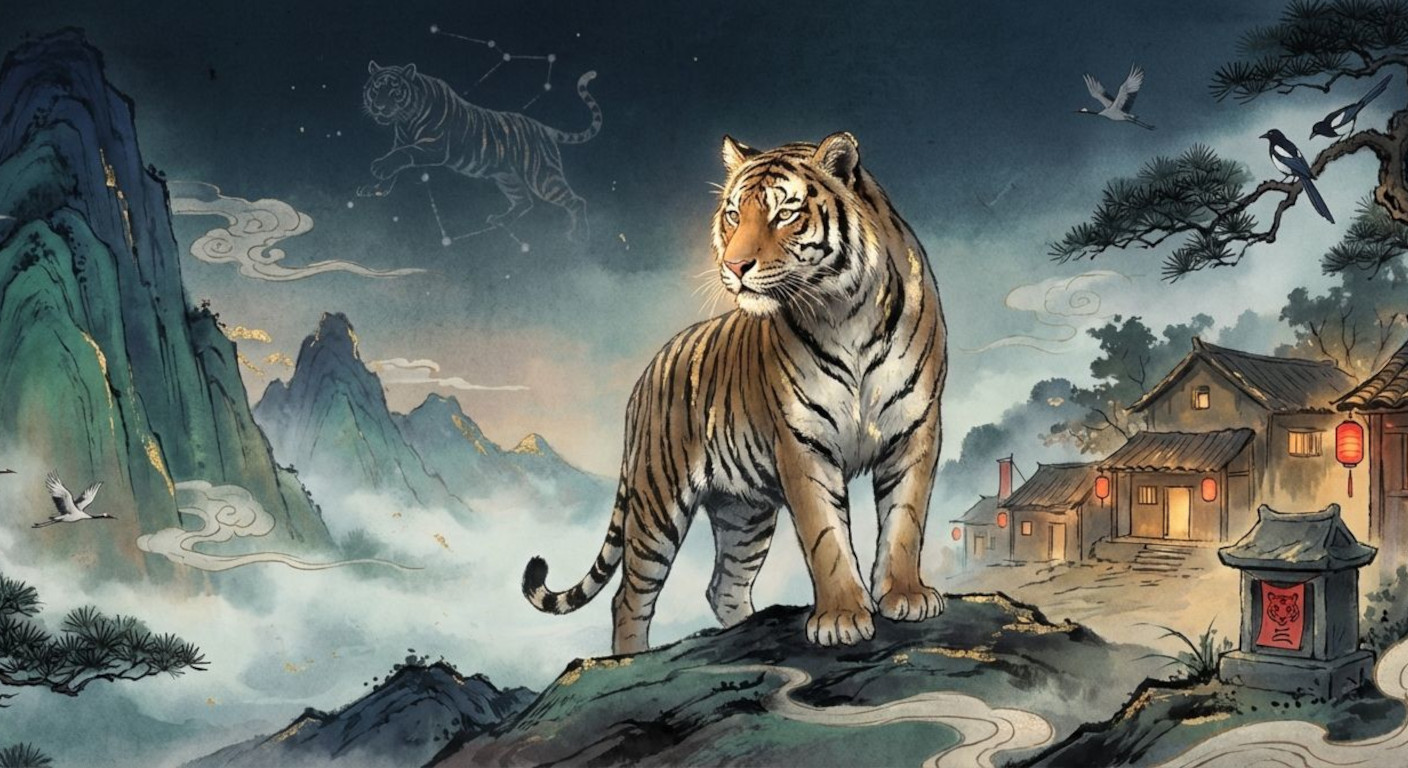
Tigers in Asian folklore occupy a unique place among animal symbols: they are simultaneously feared predators, guardian spirits, royal emblems and cultural metaphors. Across the Asian continent, from the forests of India to the mountains of Korea and the islands of Japan, stories about the tiger reflect local environments, historical encounters, and spiritual systems. This article maps those contours, explaining the symbolic, spiritual and historical roles of the tiger and offering popular tales, curiosities and examples of artistic influence.
Why the tiger matters: an overview of symbolism
The tiger’s significance stems from a few interlinked factors:
- Physical power: As one of the largest predators in Asia, the tiger naturally became a symbol of strength, ferocity and royal authority.
- Ecological presence: Tigers lived alongside many Asian societies; encounters shaped folklore about protection, danger and reverence.
- Border figure: The tiger often stands at thresholds — between mountains and villages, human and spirit worlds — making it apt as a guardian or liminal being.
- Religious integration: Tigers were incorporated into Buddhist, Hindu and indigenous cosmologies, sometimes as deities, sometimes as demons, and sometimes as vehicles for gods.
Regional traditions and major themes
Although tiger symbolism varies regionally, some recurring themes appear across Asia. Below we explore the most significant national and cultural traditions.
China: the White Tiger, the cardinal guardian and imperial emblem
In Chinese cosmology the tiger is one of the Four Symbols (Si Xiang) — the White Tiger (Baihu) representing the west and autumn. As a cosmic guardian it embodies martial power and protection. Traditional Chinese art, temple banners and funerary iconography often include tiger imagery to ward off evil spirits. Tigers also appear in folk religion: villagers placed tiger talismans to protect homes and used tiger effigies in ritual dramas to symbolize victory over malevolent forces.
Historically, the tiger’s association with rulership and martial virtues made it a common motif on armor and banners. Emperor-level symbolism and local cults overlapped: generals invoked the tiger for bravery while rural families sought tiger imagery to safeguard fields and children. For further reading on Chinese animal symbolism see Britannica’s overview on Chinese mythology and animal symbolism (Britannica).
Korea: the tiger as guardian, trickster and national symbol
In Korea the tiger carries a rich ambivalence: revered as a guardian of the mountains and protector against evil, yet also cast as a figure of trickery and mirth in folk tales. The Korean tiger appears in minhwa (folk paintings), where stylized tigers often accompany magpies to symbolize good news and protection. Popular stories portray tigers as both fearsome spirits and buffoonish characters outwitted by cunning humans — a duality that reflects human attempts to domesticate fear through humor.
Korean shamans sometimes invoked tiger spirits during rituals. The image of the tiger continues to be a powerful national icon, appearing in modern media, sports mascots and artistic revivals.
Japan: from kami to yokai — the tiger’s place in Japanese imagination
Japan’s relationship with the tiger is shaped by cross-cultural flows from China and Korea and by local reinterpretation. Tigers are less frequent in native fauna, so historical tiger imagery often arrived via imported Chinese Buddhist prints and court art. In Japanese art, tigers appear as symbols of strength in samurai culture, and as motifs in ukiyo-e prints. They also become part of the yokai (supernatural) taxonomy, sometimes fused with local spirits to create new mythic figures.
The tiger’s imagery in Japanese religious contexts often intersects with Buddhist iconography — for example, guardian deities seated on or accompanied by tigers. Many samurai-era crests and banners borrowed tiger motifs to express ferocity and prestige.
India and South Asia: tiger as sovereignty, divinity and fear
In India the tiger is deeply woven into religious narratives, royal symbolism and ecological memory. The goddess Durga, for instance, is frequently depicted riding a tiger or lion, symbolizing her mastery over power and destruction. The tiger’s presence in Hindu epics and local folktales often denotes royal authority and the natural world’s ferocity.
In regions of Bengal and northeastern India, the tiger figures in folktales as both a literal danger and a supernatural being. Colonial histories and conservation struggles later reframed the tiger as a national and cultural emblem — seen in modern state imagery and literature.
Southeast Asia: spirits, guardians and animist practices
Throughout Southeast Asia, tigers feature in animist traditions and local cosmologies. In parts of Indonesia, Malaysia and Thailand, tiger spirits (or tigers as manifestations of ancestral power) are central to shamanic practices. Tigers are both feared as agents of sudden death and respected as carriers of ancestral authority. Traditional dancers and masks sometimes portray tiger personas that mediate between community and spirit world.
Common motifs and their meanings
Across these regions several motifs repeat, each with layered interpretations:
- Guardian/Protector: The tiger as defender at village thresholds or temple gates.
- Royal power: Tiger imagery in regalia, crests and martial symbolism.
- Vehicle of deities: Like Durga’s mount or attendants to warrior gods.
- Trickster or antagonist: Folktales where tigers are outwitted, humanized or punished.
- Border being: Liminal creature bridging life and death, human and spirit spheres.
Representative folktales and myths
Below are condensed versions of widely told stories that exemplify tiger roles in folklore:
The Village Protector (East Asia)
A common tale features a village plagued by bandits or a spirit; a tiger appears and scares away the threat. Villagers erect a shrine or paint a tiger on gates to honor its protection. Such tales explain the presence of tiger talismans and shrine effigies—symbols meant to keep communities safe.
The Tiger and the Hunter (India/South Asia)
Many Indian folktales tell of hunts that go wrong: the hunter is humbled by the tiger or revealed to have been spared by a divine tiger who tests human virtue. These stories often become moral lessons about pride, respect for nature and divine justice.
The Trickster Tiger (Korea)
Korean folktales sometimes depict tigers as foolish or gullible, tricked by a clever commoner. These stories humanize fear and make social commentary possible—mocking elites or reassuring villagers that wit can tame brute force.
Tiger imagery in art, textiles and ritual
Tigers appear across multiple media: temple carvings, folk paintings (minhwa), royal emblems, textiles and modern popular culture. Artists emphasize different aspects depending on purpose: intimidating stripes for martial banners, stylized smiling tigers in folk paintings to comfort children, and realistic depictions in naturalistic studies.
Examples of material culture include:
- Minhwa paintings in Korea showing the tiger as a companion to birds.
- Chinese funerary tiles and Qing dynasty robes bearing tiger motifs as protective symbols.
- Indian temple reliefs and Durga images where the tiger signifies divine power.
Academic collections and museum catalogs (for instance, the Metropolitan Museum of Art) can be consulted for image references and provenance research.
Modern legacies: conservation, nationalism and pop culture
The colonial and modern eras transformed tiger symbolism. Conservation movements reframed the tiger as a species to be saved, linking ecological science with cultural pride. Many Asian nations adopted the tiger in state iconography and popular media, from sports teams to comics. The animal’s image today negotiates between conservation urgency and commercial appropriation.
However, the tiger’s mythic roles persist: festivals still feature tiger dances, talismans remain in rural households, and contemporary artists revisit tiger motifs to comment on identity, power and environmental loss.
Curiosities and lesser-known facts
- White tiger symbolism: While biologically rare, white tigers acquired special mythic resonance in parts of East Asia, often linked to the White Tiger guardian.
- Tiger pandas juxtaposition: In several modern artworks artists juxtapose tiger and panda imagery to discuss differing cultural narratives of strength and gentleness.
- Shamanic possession: In some animist traditions, tiger spirits could possess shamans, granting them authority but demanding ritual reciprocity.
How to explore this topic further (sources and study tips)
Start with comparative overviews in encyclopedias and then move to regional studies and folklore collections. Useful starting points include general reference works (e.g., Britannica’s tiger entry) and museum catalogs for visual analysis (e.g., The Met). For deeper academic reading, search JSTOR or university presses for regional folklore studies and ethnographies on shamanism, temple practices and local narratives.
Conclusion
The story of tigers in Asian folklore is a story of complexity: a creature that evokes fear, protection, sovereignty and sacred presence. Across diverse geographies and histories, the tiger served as a canvas for human hopes, anxieties and values. Whether as guardian at a village gate, mount of a goddess, or playful figure in a folktale, the tiger continues to shape and reflect Asian cultural identities.
Understanding these layered meanings enriches our appreciation of regional art, ritual and storytelling. If you’re curious to continue, explore regional folktale collections, visit museum catalogs, and observe how contemporary artists rework tiger imagery to address modern questions about ecology, identity and power.