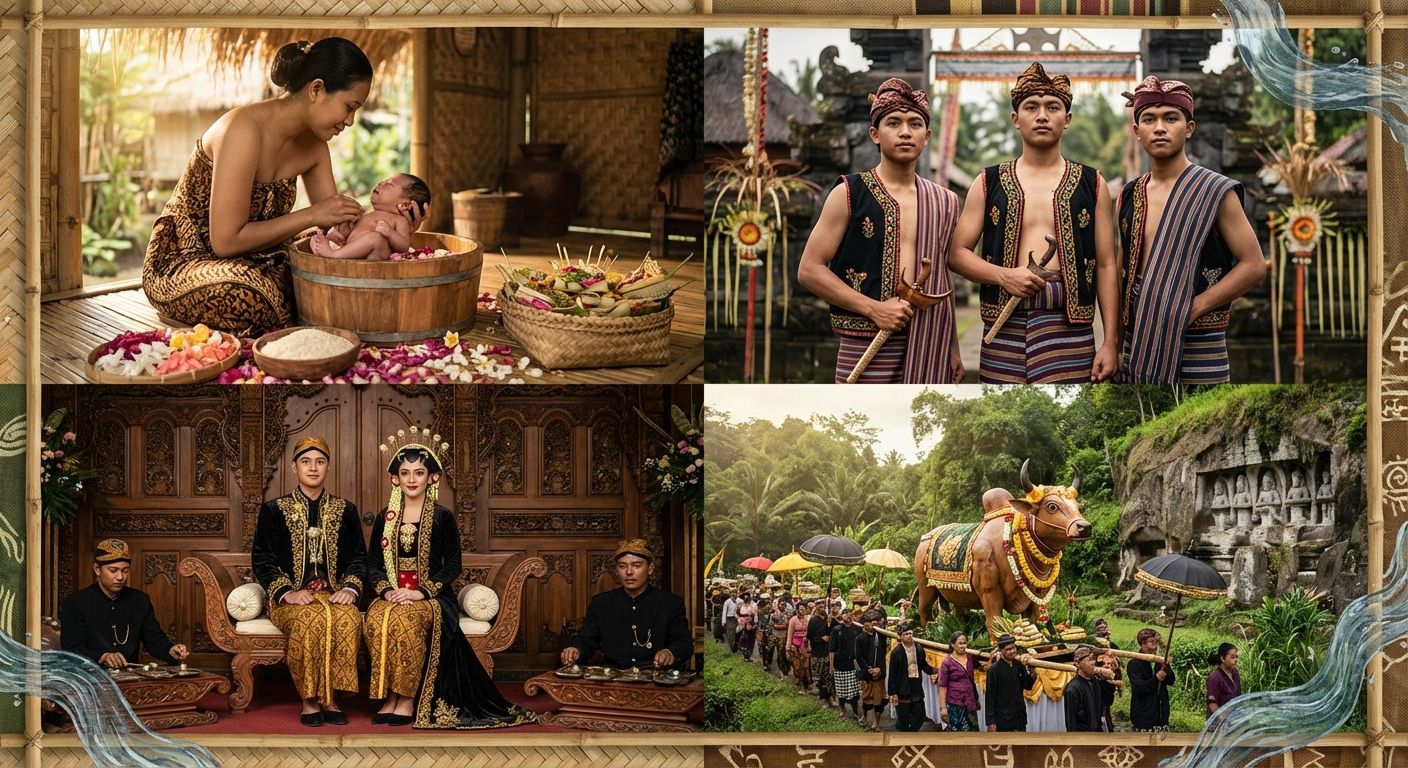
Rites of passage in Indonesia span a rich tapestry of ceremonies that mark life’s major transitions. From the moment of birth to initiation, marriage and death, Indonesian societies combine religious doctrine, local adat (customary law) and centuries-old symbolism to create rituals that both bind communities and express spiritual meanings.
Introduction: Why rites of passage matter
Understanding rites of passage is essential for anthropologists, students, and travelers who wish to appreciate how identity, community and religion are negotiated in Indonesian life. These ceremonies are not merely rites; they encode social hierarchy, cosmology and communal memory. This article explores prominent examples across major islands—Java, Bali, Sumatra, Sulawesi, and Toraja in Sulawesi—explaining origins, religious influences and regional variations.
What constitutes a rite of passage?
Scholars often follow Arnold van Gennep’s three-stage model—separation, liminality and incorporation—to analyze initiation ceremonies and life-cycle rituals. In Indonesia, these stages appear in varied forms: a newborn may be ritually separated from the polluted world, pass through naming or purification rites, and finally be incorporated into the clan. Throughout the archipelago, rites may include prayers, offerings, symbolic meals, sacrificial acts, and performative arts.
Birth and newborn ceremonies
Birth rituals in Indonesia fuse biomedical realities with symbolic protection and welcome. Common elements include blessings, naming ceremonies and rituals intended to cleanse mother and child.
Islamic-influenced practices
In predominantly Muslim areas (e.g., Java, Aceh, parts of Sumatra), early rites often follow Islamic norms: recitation of the adhān into the infant’s ear, ritual circumambulation of the family home for protection, and the aqiqah ceremony—slaughtering an animal as an offering and distributing meat to the poor. These acts blend charity, purification and thanksgiving and reflect the interface between religion and social obligation.
Balinese and Hindu-influenced newborn rites
On Bali, Hindu cosmology shapes birth rites. The tawur kesanga and naming ceremonies include offerings to household gods, water purification, and symbolic gestures to ensure the child’s balance with the cosmos. Naming may occur several days after birth and involves priests, family elders and ritual songs.
Local indigenous practices
Across eastern Indonesia and in rural areas, animist beliefs persist: charms, protective amulets, or ritual midwives (dukun) are engaged to protect infants. In some communities, special postnatal seclusion and diet rules govern mother-child recovery, reflecting a deep link between health beliefs and ritual behavior.
Initiation and coming-of-age ceremonies
Rites marking passage from childhood to adulthood are varied but central. They may be gendered, involving circumcision for boys or symbolic seclusion/education for girls.
Circumcision (khitan) and male initiation
In Muslim-majority Indonesia, khitan (circumcision) is one of the most widespread initiation practices for boys. Although religiously rooted, the practice often has strong social dimensions: public feasts, gifts and community celebration. In some regions, large-scale mass circumcision events bring social prestige and reinforce collective identity.
Female initiation and puberty rites
Female rites vary more widely. Some communities observe seclusion periods, ritualized instruction in household duties, or symbolic ceremonies that mark pubertal transformation. In parts of eastern Indonesia, girls may participate in coming-of-age dances and receive blessings that connect fertility cycles to ancestral lineages.
Toraja adolescence rituals
Among the Toraja in Sulawesi, complex social hierarchies shape initiation into adult roles. Age sets, clan obligations, and ceremonial knowledge are transmitted in elaborate community rituals. The Toraja stress the continuity between living and dead, so initiation often includes instruction in funerary rites and social responsibilities.
Marriage rituals: Adat, religion and theatrical ceremony
Marriage in Indonesia frequently combines adat (customary law), religious practice and performative spectacle. The result varies dramatically from Javanese courtly weddings to Balinese temple-centered nuptials and Acehnese Islamic ceremonies.
Javanese wedding customs
Javanese weddings often emphasize refinement and symbolic purification. Rituals such as the siraman (pre-wedding showering), midodareni (a night before the wedding where the bride is believed to be visited by the soul of her future partner), and panggih (the meeting ritual) stage the coupling as a harmonization of cosmic forces. These ceremonies are rich in courtly aesthetics—batik, gamelan music and poetic recitations.
Balinese marriage rites
Balinese Hindu weddings are held near family temples and include offerings, priestly chants and a sequence of purification rituals. The ceremony reaffirms ties to ancestors and deities; marriage is both a social contract and a devotional act. Participants wear traditional brocaded textiles and ritual priests (pemangku) guide the process.
Muslim marriage ceremonies
Islamic marriage rituals across Indonesia center on the nikah contract, dowry negotiation (mahr), and community prayer. Local customs frequently add pre-wedding bargaining and celebratory feasts a.k.a. selamatan—a communal ritual meal that marks life events and social solidarity.
Funeral rites and the treatment of the dead
Funerary practices in Indonesia demonstrate striking regional diversity, ranging from simple Islamic burials to massive ritual spectacles like the Toraja funeral or the Balinese ngaben (cremation).
Balinese ngaben (cremation)
The Balinese ngaben is a highly symbolic cremation ceremony intended to release the soul (atma) to the next life. Families may delay cremation until they can afford an elaborate ritual, which involves processions, effigies, gamelan orchestras and symbolic crematory towers. The ritual underscores Hindu beliefs about rebirth and karmic balance. For an overview, see the Britannica entry on Ngaben.
Toraja funerals: social theater and ancestral exchange
Toraja funerals are among Indonesia’s most complex rites. The deceased may be kept at home for months or years while relatives prepare a grand funeral that can include buffalo sacrifices, traditional dances, and the construction of elaborate tombs. Funerals reaffirm social status, redistribute wealth, and maintain ties with ancestors; for many Toraja, the proper funeral ensures the deceased’s social promotion in the afterlife.
Islamic burial practices
In Muslim communities, burial custom emphasizes cleanliness, quick burial, and prayer. Practices include ritual washing (ghusl), shrouding (kafan), and a communal grave. Local adat often layers additional practices, such as offerings or visits to cemeteries on commemorative days.
Religious influences and syncretism
Indonesian rites of passage demonstrate extensive syncretism. Hindu-Buddhist elements persist in Bali and in certain Javanese court traditions; Islam shapes rituals across the archipelago’s majority; while animist and ancestral beliefs remain strong in many rural and eastern island contexts. The interplay of these traditions results in layered ceremonies where priests, imams, shamans (dukun) and community elders all may participate.
Regional variations and island differences
Indonesia’s archipelagic geography produces local diversity. Useful examples:
- Java: Javanese court and peasant customs emphasize refinement, gamelan music and syncretic Islamic-Javanese rituals.
- Bali: Hindu cosmology, temple rites and elaborate cremation ceremonies dominate life-cycle rituals.
- Sumatra: Acehnese and Minangkabau have strong Islamic traditions; Batak and other groups maintain indigenous funerary customs.
- Sulawesi (Toraja): Funerary spectacles and ancestor veneration are central.
- Papua and Maluku: Diverse indigenous practices, including initiation dances, ornamentation and clan-based feasts.
Symbolism and meanings
Key symbolic threads include purification (water, smoke), transformation (costume, masks), exchange (gift-giving, sacrificial animals) and public recognition (feasts, processions). Rites of passage often aim to: protect individuals from spiritual danger, legitimize social roles, reaffirm kinship ties, and negotiate wealth redistribution.
Practical tips for visitors and researchers
- Ask permission before photographing ceremonies; many rites involve sacred moments not for public view.
- Respect dress and behavior: modest clothing and quiet observation are expected at many rituals, especially in Muslim areas and temple ceremonies.
- Use local guides who understand adat and social protocol; this benefits both research and respectful tourism.
- Be aware of ethical issues: payment for access, commercialization of rites, and the effect of tourism on traditional practices should be critically considered.
Contemporary changes and resilience
Modernization, urban migration, formal religious education and tourism reshape rites of passage. Some ceremonies have become shorter or privatized; others have been revitalized as heritage attractions. Despite change, many communities actively preserve ritual knowledge through family elders, religious institutions and local cultural organizations.
Further reading and sources
For deeper research, consult ethnographies and reputable reference sources. Good starting points include:
- Britannica: Indonesia — overview of cultural and religious history.
- Britannica: Ngaben — on Balinese cremation rites.
- UNESCO — documentation of cultural heritage and intangible traditions in Indonesia.
Conclusion
Indonesia’s rites of passage reveal how communities understand life, death and social belonging. Whether through the intimate naming of a newborn, the communal feast of a wedding, or the theatrical grandeur of a Toraja funeral, these rituals persist as living expressions of belief and social order. For students, travelers and researchers, careful observation and cultural humility provide the best path to meaningful engagement with these traditions.
Keywords and LSI terms used: rites of passage, coming-of-age, initiation ceremonies, birth rituals, wedding customs, funeral rites, ngaben, Toraja funerals, adat, khitan, nikah, Balinese ceremony.