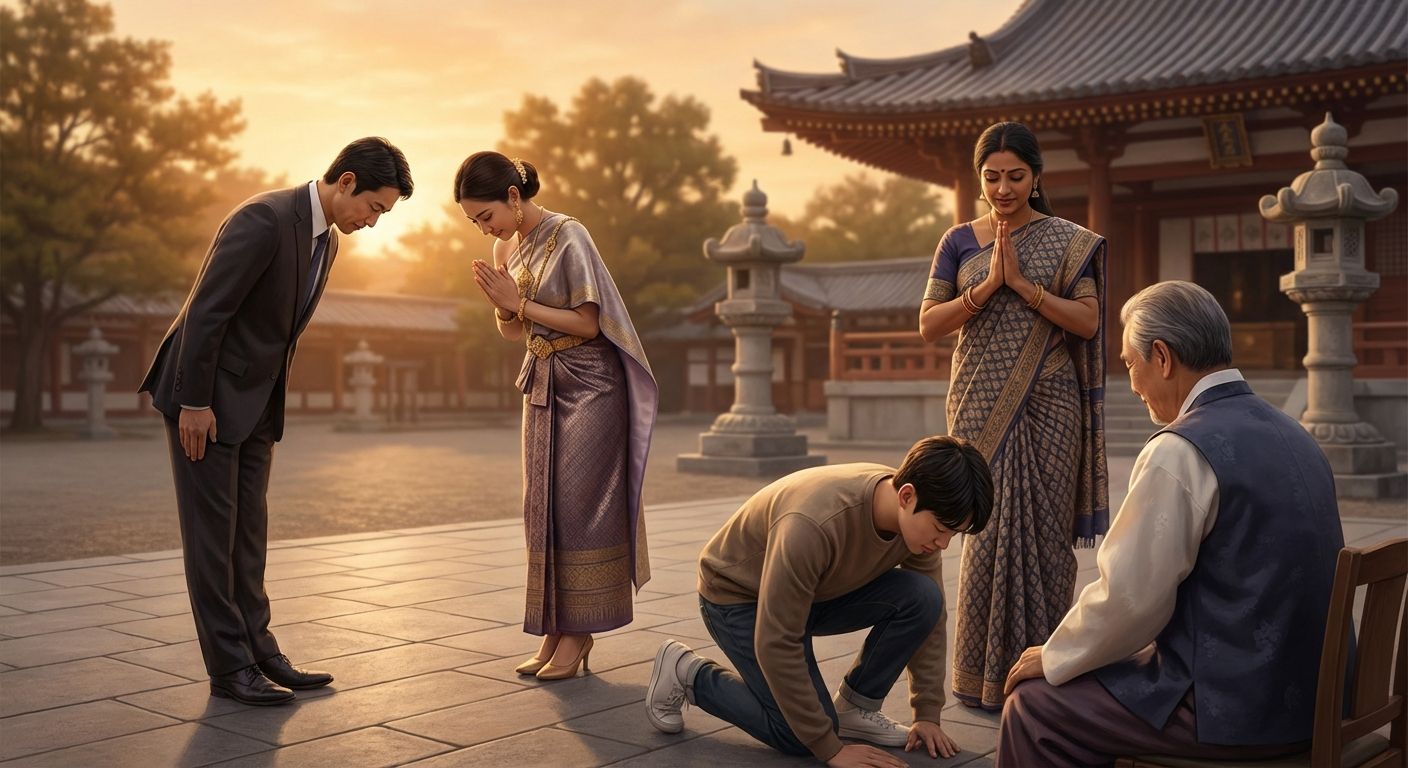
The bowing is a deceptively simple gesture with deep cultural resonance across Asia. From a quick nod to a profound prostration, bowing communicates a complex set of meanings — greeting, respect, apology, gratitude or religious devotion — depending on the country, context and form. This guide explains those differences, offers historical background and gives practical advice for travelers and students of culture.
Why the bowing matters: cultural logic and social function
Bowing is an embodied grammar of social relations. In many Asian societies, it physically maps social hierarchies and interpersonal distance. A bow can be:
- Hierarchical — indicating rank, age or status;
- Ritual — part of religious worship or ancestral veneration;
- Expressive — showing apology, gratitude or congratulations;
- Polite — a neutral greeting replacing or accompanying verbal salutations.
Understanding these functions helps visitors read social cues and respond appropriately. The same physical movement can carry different weight: a shallow nod may be casual, while a full kneeling bow can signal deep contrition.
Historical roots and religious influences
Bowing in Asia has layered origins. Confucian values emphasized social order, filial piety and ritual propriety, reinforcing hierarchical bowing in East Asia. Buddhism, with practices of prostration and reverence for the Buddha, spread bowing into South and Southeast Asia. Hindu greetings like namaste (hands pressed, slight bow) blend spiritual recognition with everyday politeness. These traditions intersect and evolve with local customs.
For deeper reading on historical and religious roots, see resources such as Britannica on Confucianism and articles about Buddhist devotional practice by reputable universities.
Country-by-country: how the bowing is expressed
Japan: ojigi — precision, gradation and business etiquette
In Japan, the bowing is called ojigi. It is highly codified by angle, duration and body movement. Broadly:
- 15° (eshaku) — casual greeting among equals;
- 30° (keirei) — polite bow used in business or with strangers;
- 45°+ (saikeirei) — deep bow used to express profound apology or gratitude.
Japanese business culture values timing and subtlety: eye contact is limited during a bow, hands remain at the sides, and the back remains straight. For business travelers: mirror the other person’s angle and duration; in formal settings, follow the senior person’s lead. For background reading on Japanese etiquette, check Japan Guide on bowing.
Korea: jeol and the grammar of respect
Korean bows (known broadly as jeol) vary from quick nods to deep, kneeling prostrations used during ancestral rites (charye) or New Year greetings (sebae). In daily life a small bow or nod with a slight inclination of the head is common. Younger people traditionally lower their gaze and bow to elders as an expression of filial respect. Business contexts combine bows with handshakes when dealing with international partners.
China: nods, slight bows and the shadow of the kowtow
In mainland China, the bowing historically included the full prostration called kowtow (ketou), especially in imperial or ritual contexts. Today, casual greetings often rely more on handshakes or nods, especially in urban and international contexts. Slight bows or head inclinations remain polite in formal settings. Traditional prostration still appears in religious contexts (e.g., Buddhist temples) and some ceremonies. When visiting religious sites, watch local worshippers and follow their lead.
Thailand: the wai — hands and head tilt
In Thailand the typical greeting combines hand position and a bow: the wai. The hands are pressed together in a prayer-like gesture while the head inclines slightly. The height of the hands signals respect — higher hands indicate greater respect — and the wai is often accompanied by a verbal greeting. For example, younger people wai older people; service staff will wai customers. It’s polite to return the wai but not to initiate a wai to someone clearly of much higher status unless they wai first.
India and South Asia: namaste, namaskar and folded hands
Across India and parts of South Asia, the folded-hands gesture accompanied by a slight bow — namaste or namaskar — is common. It expresses recognition of the other’s dignity and can be used for greeting, thanks or spiritual reverence. Unlike full prostrations, namaste is usually performed standing and works in both casual and formal contexts. During the COVID-19 pandemic, it also gained popularity as a non-contact greeting worldwide.
Southeast Asia: regional variations (Cambodia, Laos, Myanmar, Vietnam)
Many Southeast Asian cultures have gestures akin to the wai or namaste: Cambodia’s samlé, Laos’ similar greeting and Myanmar’s respectful gestures. Cambodia also preserves royal and religious prostrations in certain ceremonies. Vietnam commonly uses a slight bow or nod; in rural or religious settings deeper bows can appear.
Contexts: when different bows are used
Daily greetings and social politeness
Simple bows or nods function as everyday politeness. They are shorter and shallower — enough to show attention and respect without implying deep deference.
Business and formal settings
In business, the bowing signals professionalism and respect. Learn local norms: in Japan and Korea, bowing is integral; in China, a handshake combined with a nod is common. Mirror senior colleagues and allow them to initiate the degree of formality.
Apology and gratitude
Deeper bows express apology or profound gratitude. For example, a 45° bow in Japan or a prostration in some religious rites communicates humility and remorse. Never downplay or mimic such expressions; treat them seriously.
Religious practice
Bowing during worship — whether a Buddhist prostration, a Hindu namaskar, or Shinto rituals — is an act of devotion and humility. Observers should be respectful, avoid interrupting rituals and follow the lead of worshippers when in doubt. Many temples provide guidelines for visitors online or at the entrance.
Practical tips for travelers and learners
- Observe first: when unsure, watch how locals behave and mirror them.
- Match the angle: for formal encounters, gently mirror the other person’s bow depth and duration.
- Combine with verbal cues: a polite “thank you” or local greeting alongside a bow is usually appreciated.
- Respect religious contexts: remove shoes when required and follow temple rules; avoid pointing feet toward altars.
- Use hands appropriately: in Thailand and India, the placement of hands matters; in Japan keep hands at your sides.
- Avoid exaggerated mimicry: jokingly overdoing a bow can be offensive; be natural and sincere.
Common mistakes and how to avoid them
Visitors often make errors out of good intentions. Common pitfalls:
- Overdoing a bow as a caricature of local customs. Keep it respectful and measured.
- Using the wrong hand gesture — for example, offering a handshake in a setting where a wai is expected.
- Failing to recognize hierarchy — ignoring who should bow first (e.g., younger to elder) can be perceived as rude.
When in doubt, ask politely or follow local companions. A sincere attempt to respect local customs usually goes a long way.
Language, semantics and alternative terms
Use the term that fits context: bowing, prostration, kowtow, wai, namaste, and jeol — a religious prostration is not the same as a polite nod. Incorporating local words (e.g., ojigi, wai, namaste) demonstrates cultural literacy and precision.
Further reading and reliable resources
To expand your knowledge, consider the following reputable resources:
- Japan Guide — etiquette and ojigi: https://www.japan-guide.com/e/e2224.html
- BBC Culture and travel features on greetings and etiquette
- Britannica entries on Confucianism and ritual practice: https://www.britannica.com/
Conclusion
The bowing is more than a physical motion; it encodes respect, hierarchy and spirituality throughout Asia. By learning nuances — when to nod, when to press hands together, and when to perform a deeper bow — travelers and students can show genuine respect and engage more meaningfully with local societies. Observe, mirror and remain sincere: those are the simplest rules for navigating this rich, cross-cultural practice.
Quick traveler checklist:
- Observe local form before acting
- Match bow depth and duration in formal settings
- Use local terms like wai or namaste when appropriate
- Prioritize sincerity over performance