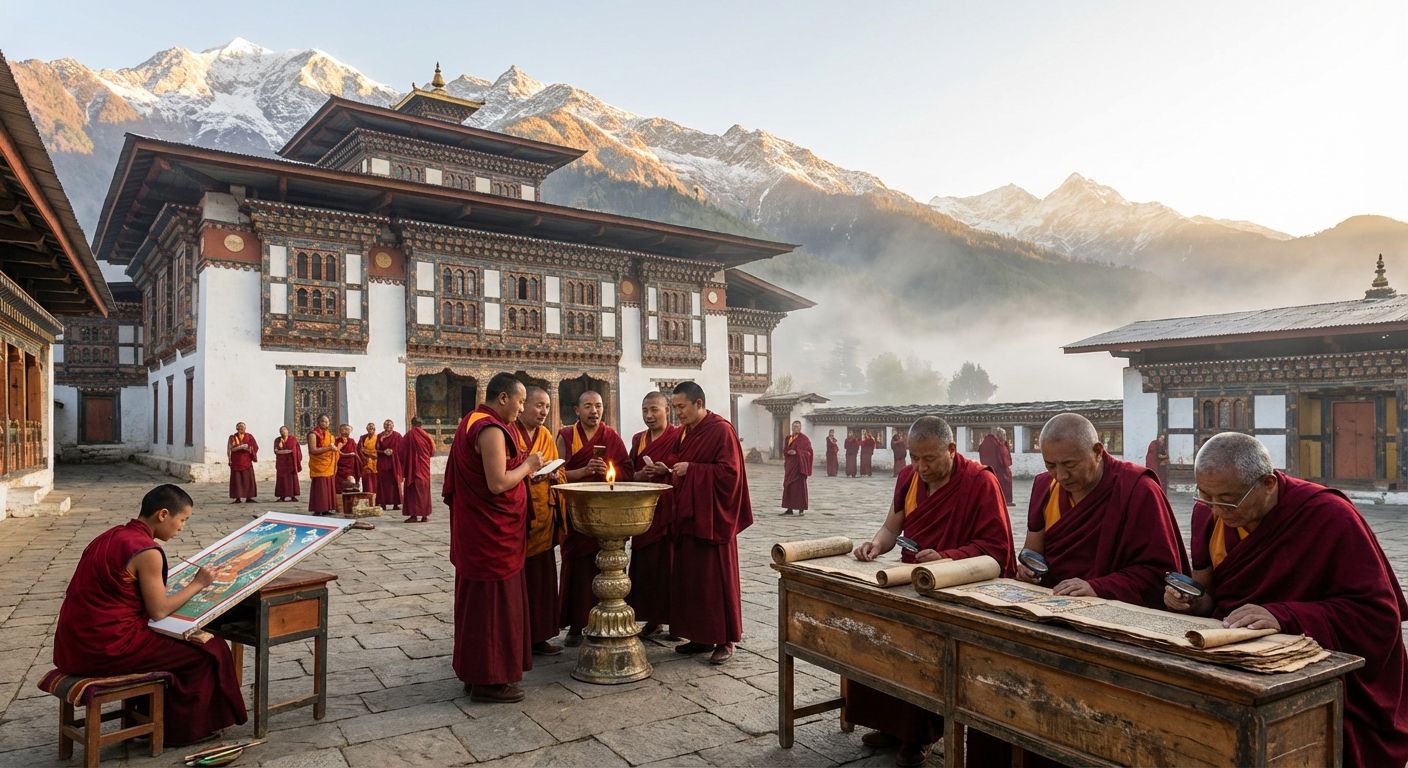
Tibetan monks are at the heart of Tibet’s cultural survival: through ritual life, education, manuscript conservation and community leadership they ensure continuity of a distinct identity that blends religion, language and artistic traditions. This article explores historical roles, concrete preservation practices, and contemporary challenges affecting Tibetan monastic life.
Introduction: Why Tibetan monks matter
In Tibet, monasteries have been more than religious centers; they have functioned as libraries, schools, art ateliers and repositories of collective memory. The monastic community — the lamas and monks — have long been custodians of oral teachings, ritual performance, scriptural manuscripts and a wide range of cultural skills such as thangka painting, ritual music and Tibetan medicine. By maintaining these living traditions, Tibetan monks help transmit identity across generations.
Historical foundations of monastic cultural stewardship
Since the introduction and development of Buddhism in Tibet (7th–11th centuries CE and beyond), monastic institutions have shaped social, educational and artistic life. Monasteries served as:
- Centers of learning— teaching philosophy, logic, metaphysics and ritual to novice monks and lay students;
- Text repositories— preserving canonical texts, commentaries and local records;
- Artistic workshops— producing thangkas, carvings, ritual implements and chant traditions;
- Social safe havens— supporting poor families and offering a shared cultural reference during periods of upheaval.
These functions made monasteries indispensable to cultural continuity: when political or environmental crises occurred, monasteries often acted to protect fragile cultural assets.
Transmission of teachings: oral and scholastic traditions
An essential mechanism for preservation is the interplay between oral transmission and scholastic training. Tibetan monastic education prioritizes memorization, debate and teacher-student lineage. Key features include:
- Lineage-based transmission: Many teachings are transmitted through uninterrupted teacher-student lineages (kagyü, gelug, nyingma, sakya schools), which certify doctrinal fidelity and ritual correctness.
- Memorization and debate: Novices memorize large volumes of texts and engage in public debate to internalize philosophical frameworks—an embodied method that resists loss even when printed materials are scarce.
- Ritual apprenticeship: Ritual roles (choruses, ritual dancers, ritual instrument makers) are learned through apprenticeship, keeping performance knowledge alive.
These traditions create redundancy—knowledge exists in text, memory and practice—which increases resilience against disruption.
Manuscript conservation and modern digitization
Manuscripts and rare books are tangible anchors of cultural memory. Monks historically copied, annotated and curated collections including Buddhist sutras, commentaries, historical chronicles and medical treatises (Tibetan medical texts such as the Gyüshi). Preservation methods have included humidity-controlled storage, periodic recopying, ritual conservation ceremonies and specialized bindings.
In recent decades, international and diaspora collaborations have combined monastic expertise with modern technology. Major efforts include digitization projects led by organizations such as the Buddhist Digital Resource Center (BDRC) and partnerships with university libraries and institutions like the Encyclopaedia Britannica or UNESCO initiatives. These programs help create digital backups of fragile manuscripts, make texts globally accessible for scholars, and enable even remote monastic libraries to preserve content against physical threats.
Monasteries as living museums and cultural hubs
Monasteries function as living museums—places where rituals, art, architecture and everyday practices are performed and taught. Areas where monks maintain cultural forms include:
- Ritual and liturgy: Complex liturgical cycles (pujas, cham dances) encode myth, history and cosmology in embodied form.
- Visual arts: Thangka painting, mural art and sculpture techniques are transmitted within monastic workshops.
- Performing arts: Cham dances, overtone chanting and ritual music preserve narrative and sonic traditions.
- Language preservation: Use and teaching of Classical Tibetan (Chökey) and local dialects sustain linguistic continuity.
Through festivals and daily ritual, monasteries keep cultural practices visible and accessible to lay communities, reinforcing identity beyond monastic walls.
Education, libraries and community knowledge
Monastic curricula teach more than theology: they include ethics, logic, history, medicine and even administrative skills required to maintain complex institutions. Monastic libraries have traditionally housed medical treatises, legal codes, genealogies and local histories—resources crucial for historians and practitioners alike.
Monks have historically acted as teachers in village settings, advising on ritual calendars, life-cycle ceremonies and indigenous knowledge—roles that anchor monastic culture within broader social life.
Challenges to monastic preservation in the contemporary era
Despite their resiliency, Tibetan monastic communities face significant modern pressures that threaten their preservation role:
- Political constraints: Policies that restrict religious practice, curtail monastic enrollment or impose oversight on monastic curricula undermine the autonomy needed for cultural continuity.
- Cultural assimilation: State-driven assimilation, language shifts and changing educational priorities can reduce the transmission of Tibetan language and ritual forms.
- Loss and dispersal of manuscripts: Looting, insecure storage and displacement put collections at risk, while travel restrictions limit international conservation collaboration.
- Economic pressures: Declining local economies and reduced monastic funding make it harder to maintain buildings, commissions and training programs.
- Climate change and environmental threats: Glacial retreat and changing weather patterns affect pilgrimage routes, monastery agriculture and preservation conditions for ancient texts.
Understanding these pressures is essential to designing effective preservation strategies.
Responses and adaptive strategies
Tibetan monks and their supporters are developing multiple adaptive responses to preserve culture:
- Digitization and open access: Scanning manuscripts and creating searchable catalogs through projects with the BDRC and university partners help secure texts and broaden scholarly access (BDRC).
- Monastic reforms: Some monasteries introduce modern administration, fundraising and language programs to increase resilience while preserving core teachings.
- Community-based education: Outreach programs teach Tibetan language, crafts and ritual skills to laypeople, encouraging multi-generational transmission.
- International networks: Diaspora monasteries in India, Nepal, Europe and North America serve as preservation nodes, offering safe spaces for training and archiving.
These strategies combine traditional monastic strengths with contemporary tools, creating hybrid approaches to preservation.
Case studies and examples
Several concrete examples illustrate how monks preserve culture in practice:
- Monastic printing presses and recopying: Historically, monks copied and printed texts by hand; modern presses and digital reproduction continue this practice to keep canonical and local texts available.
- Festival conservation: Annual festivals (e.g., Losar celebrations, monastery-specific cham dances) have been sustained by monastic direction, preserving choreography, costume-making and ritual narrative.
- Thangka workshops: Monastic ateliers teach painting techniques and iconography, ensuring that sacred icon images remain consistent and meaningful.
These activities show that cultural preservation is both practical and ritualized: it requires daily labor, ritual recognition and institutional support.
How researchers, students and practitioners can engage
Those who want to support or study monastic preservation can do so ethically and effectively:
- Collaborative research: Partner with monastic libraries and respect local protocols when accessing manuscripts. Seek partnerships that include digitization, training and capacity building.
- Ethical tourism: Visit monasteries respectfully, follow local rules and support monastery-led cultural programs and local artisans.
- Support digitization and archives: Donate or fund projects that digitize texts and train monks in digital preservation skills.
- Language and practice learning: Study Classical Tibetan or ritual arts through accredited programs and monastic courses to contribute to transmission.
Conclusion: The living, adaptive role of Tibetan monks
Tibetan monks remain indispensable guardians of Tibet’s cultural identity. Through ritual practice, rigorous education, manuscript stewardship and community engagement, they bridge past and future. While contemporary pressures are real—from political limitations to environmental change—monastic communities and their partners are adapting by combining traditional methods with modern technologies like digitization and international collaboration.
Preserving Tibetan culture is a shared responsibility: scholars, practitioners, tourists and policymakers can support monastic roles by advocating for cultural rights, funding archives and respecting monastic authority in cultural matters. By understanding and supporting the concrete work monks do—daily rituals, recitations, art production and teaching—we can help ensure that Tibet’s rich cultural legacy continues to thrive.
Further reading and trusted sources: Encyclopaedia Britannica (Tibetan Buddhism), BDRC (manuscript digitization), UNESCO cultural heritage resources.