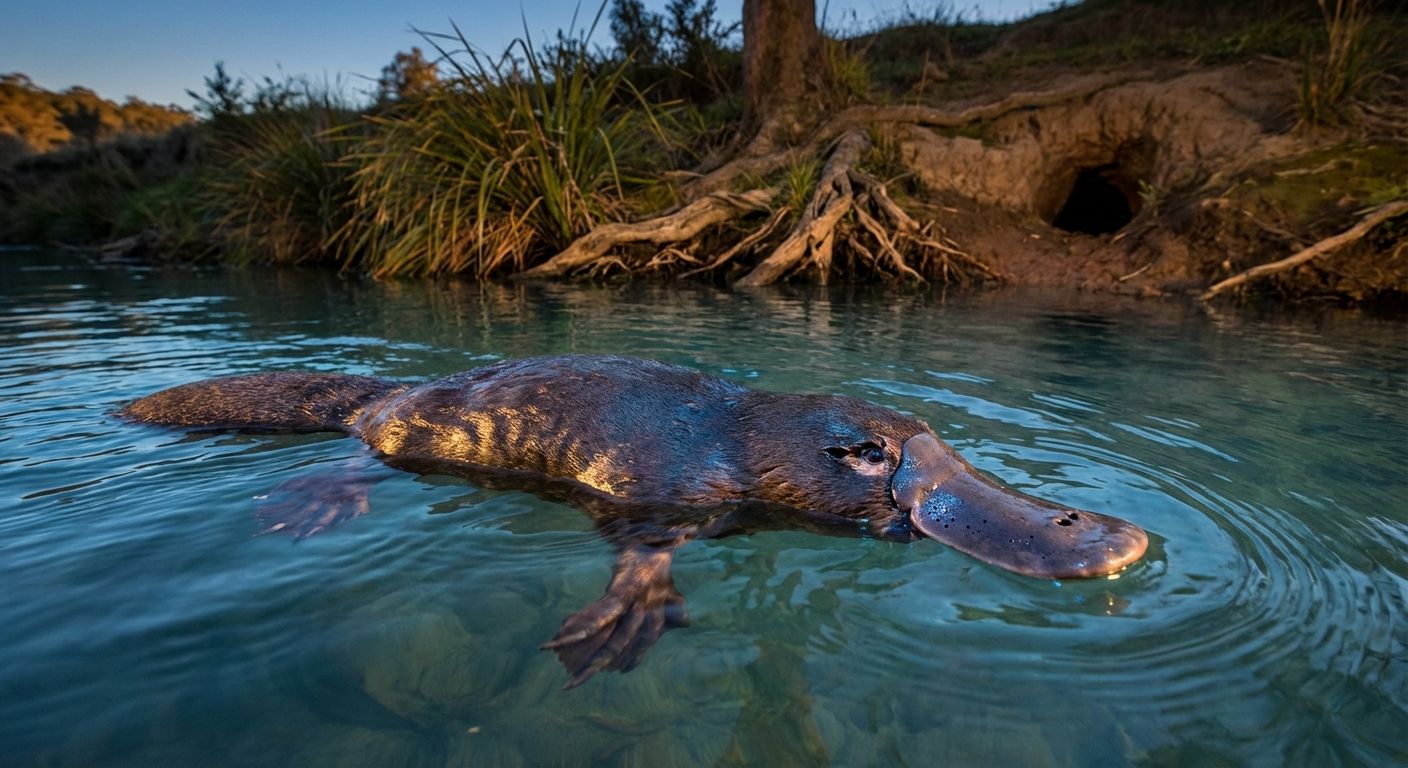
Platypus — a semiaquatic, egg-laying mammal native to eastern Australia and Tasmania — stands out in nature for its blend of odd and specialized traits. In the next sections you’ll find a clear, in-depth profile covering appearance, behavior, habitat, reproduction, and conservation, with practical links and trustworthy references.
Quick overview: what is the platypus?
The platypus (Ornithorhynchus anatinus) is a member of the monotremes, an ancient group of mammals that lay eggs. It is famous for its duck‑like bill, webbed feet, dense fur, and — in males — a venomous spur on the hind leg. These features make it a unique subject for study in zoology and evolutionary biology.
Taxonomy and evolution
Scientific classification:
- Kingdom: Animalia
- Phylum: Chordata
- Class: Mammalia
- Order: Monotremata
- Family: Ornithorhynchidae
- Genus and species: Ornithorhynchus anatinus
Monotremes (which include the platypus and echidnas) diverged early from other mammals. Fossil and genomic evidence suggest platypus ancestors retained a mix of reptilian and mammalian traits, helping scientists understand mammalian origins and the evolution of lactation and thermoregulation.
Physical characteristics
The platypus exhibits a combination of specialized physical traits adapted for a semiaquatic lifestyle:
- Bill: Soft and leathery, packed with electroreceptors and mechanoreceptors that detect prey underwater.
- Fur: Dense, waterproof fur that insulates the body during cold swims.
- Feet and tail: Front feet are webbed for swimming; the tail stores fat and helps with steering and burrow construction.
- Venomous spur: Males have a spur connected to a venom gland; deliveries can cause severe pain in humans and are used in male competition.
- Size: Body length ranges from about 30 to 45 cm (12–18 in), with males generally larger than females.
Sensory adaptations: electroreception and touch
One of the most remarkable features of the platypus is its ability to locate prey using electroreception. The bill’s skin contains thousands of sensory receptors that pick up weak electrical signals generated by the muscle contractions of insects, larvae, and small crustaceans. When foraging, the platypus closes its eyes, ears and nostrils and relies almost entirely on bill sensing.
Behavior and diet
Feeding behavior: Platypuses are primarily nocturnal or crepuscular. They forage along riverbeds, scooping up prey and storing it in cheek pouches to chew on the surface. Their diet includes aquatic invertebrates, insect larvae, small crustaceans, and occasionally small fish.
Social behavior: Generally solitary outside the breeding season. They use burrows on riverbanks for resting and nesting. Courtship and mating behaviors occur in water, with males sometimes defending territories or competing for females.
Reproduction and life cycle
Egg-laying mammals: Female platypuses lay one to three leathery eggs and incubate them in a nest inside a burrow for about ten days. After hatching, the mother nurses the young; she lacks teats, so milk is secreted through pores and pools on specialized grooves on her skin, where the young lap it up.
The juvenile period lasts several months, during which the young gain weight rapidly and learn to forage. Sexual maturity is reached at roughly 1–2 years of age.
Habitat and distribution
The platypus inhabits freshwater ecosystems across eastern Australia, including Queensland, New South Wales, Victoria, and most of Tasmania. Preferred habitats include:
- Slow-flowing rivers and creeks with vegetated banks
- Freshwater lakes and ponds
- Streams with soft banks for burrow excavation
Healthy riparian vegetation and stable water flows are critical for burrow integrity and prey availability. For more detailed distribution maps and species data, consult the IUCN Red List and the Australian Museum.
Conservation status and threats
The IUCN currently lists the platypus as Near Threatened in some regions due to habitat degradation, water pollution, altered river flows, and climate change-related droughts. Threats include:
- River regulation, dams and reduced stream flows
- Loss of riparian vegetation and increased erosion
- Pollution and pesticide runoff reducing prey availability
- Predation by introduced species (dogs, foxes) and accidental capture in nets
Conservation actions focus on restoring river habitats, improving water quality, and protecting riparian corridors. Researchers and citizen science projects also monitor populations; see local initiatives such as National Geographic and regional conservation groups for ways to get involved.
Interesting facts and curiosities
- Unique mix of traits: The platypus combines mammalian fur and lactation with egg-laying — a living example of evolutionary mosaicism.
- Electroreception: Only a few mammals (notably monotremes and some marine mammals) use electroreception to find prey.
- Venom: Male platypuses produce venom in the breeding season; the chemical composition is under study for medical insights.
- Cultural significance: The platypus appears in Indigenous Australian stories and is an emblematic species for Australian biodiversity.
How to observe platypuses responsibly
If you’re a wildlife enthusiast hoping to see a platypus in the wild, follow ethical guidelines:
- Visit at dawn or dusk when they are most active.
- Keep a respectful distance and avoid disturbing bank vegetation or burrows.
- Use binoculars and silent observation to avoid stress to the animals.
- Support habitat protection by following local regulations and leaving no trace.
Consider visiting established reserves or guided tours operated by knowledgeable local guides; for additional reading, check the BBC Earth profile.
Suggested internal links and further reading
External authoritative sources include the Australian Museum, IUCN, and National Geographic.
Frequently asked questions (FAQ)
Are platypuses dangerous to humans?
Male platypuses can deliver painful venomous kicks during the breeding season, but they are not typically aggressive toward humans and fatalities have not been recorded. Exercise caution and avoid handling wild animals.
Do platypuses make good pets?
No. Platypuses are wild animals with specialized needs, and they are protected by law in Australia; keeping one as a pet is illegal and unethical.
How long do platypuses live?
In the wild, platypuses typically live around 10–17 years, though lifespan varies based on habitat quality and threats.
Conclusion
The platypus remains a compelling emblem of evolutionary novelty and ecological specialization. By understanding its biology, behavior and conservation needs, educators, students and wildlife enthusiasts can promote informed stewardship. Protecting freshwater habitats and supporting monitoring efforts are essential to ensure this extraordinary mammal persists for future generations.
Recommended next steps: explore local conservation pages, read the linked authoritative sources, and consider contributing to citizen science projects that monitor platypus populations.