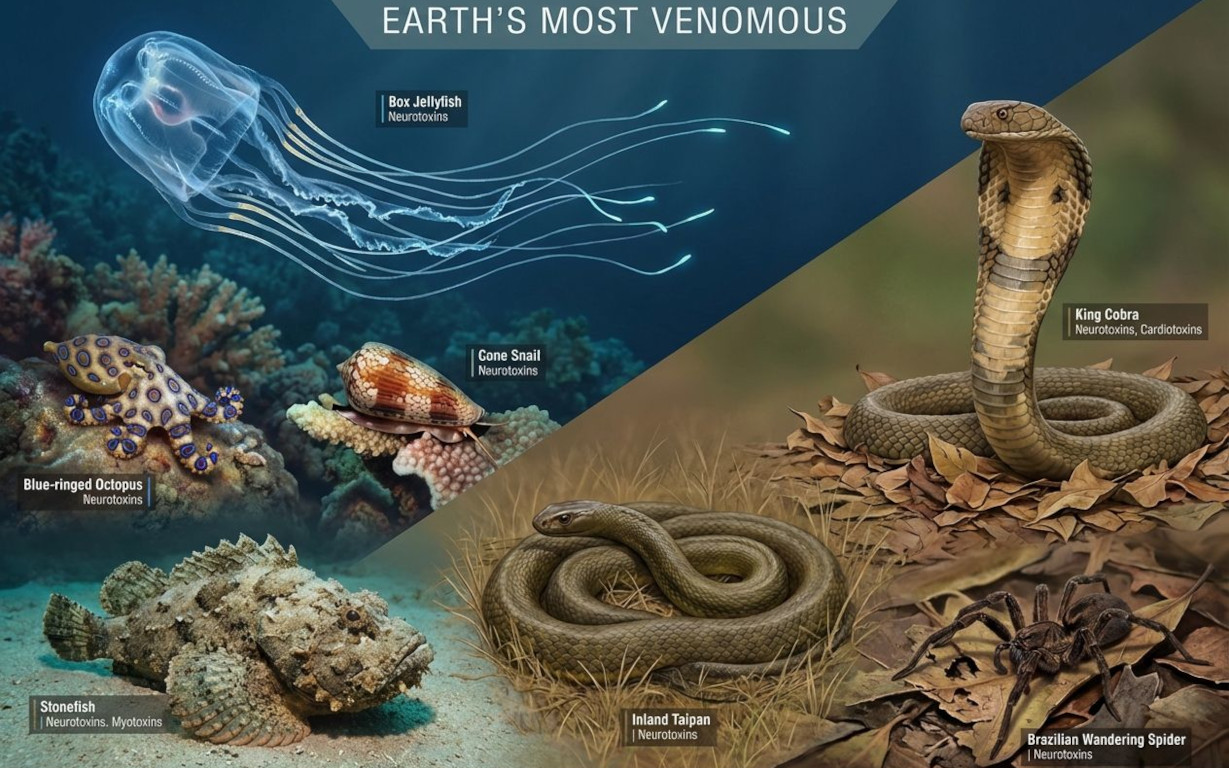
Venomous animals are species that produce specialized toxins to immobilize prey or defend themselves; this guide explores the 20 most dangerous ones, their habitats, toxicity levels and surprising scientific facts.
Introduction
Venom plays a pivotal role in ecology and evolution. From tiny marine invertebrates to large reptiles, venomous species use biochemical arsenals composed of peptides, proteins and enzymes to affect nervous, cardiovascular and cellular systems. This article is aimed at wildlife lovers, students, amateur biologists and anyone fascinated by dangerous animals. You’ll find clear descriptions, scientific context, and safety tips.
How venom works & why it matters
Venom is a biological secretion delivered by a bite, sting or other specialized structure. The components of venom vary widely but commonly include neurotoxins, cytotoxins, cardiotoxins and hemotoxins. These molecules can block ion channels, disrupt cell membranes, or affect blood clotting.
Key terms and concepts:
- Neurotoxin: affects the nervous system (e.g., cone snails, some snakes).
- Cytotoxin: damages or kills cells locally (e.g., some spiders and snakes).
- Hemotoxin: disrupts blood clotting or destroys red blood cells (e.g., some vipers).
- LD50: a standard measure of toxicity (lethal dose for 50% of test subjects) used in toxicology.
Venomous vs. poisonous
Many people mix up venomous and poisonous. A venomous animal injects venom (e.g., a snake bite). A poisonous animal is harmful to eat or touch (e.g., poison dart frogs). This article focuses exclusively on animals that actively deliver venom.
Methodology and ranking notes
The phrase “most venomous” can mean different things: lowest LD50, most medically significant to humans, or greatest ecological potency. This list blends these perspectives: documented human lethality, venom potency in laboratory measures, and clinical significance. Sources include peer-reviewed research, toxinology databases and trusted science outlets (e.g., National Geographic, CDC, and the IUCN).
The 20 Most Venomous Animals
Each entry lists the common name, scientific name, primary toxin type, typical habitat, level of toxicity and interesting facts.
1. Box Jellyfish (Chironex fleckeri)
Toxin: Powerful cardiotoxins and neurotoxins. Habitat: Coastal waters of northern Australia and Indo-Pacific. Toxicity: Extremely high; stings can cause cardiovascular collapse and death within minutes.
Curiosity: The box jellyfish’s tentacles can deliver venom through thousands of nematocysts. Vinegar and prompt medical care (antivenom in severe cases) are critical. See NSW Health.
2. Inland Taipan (Oxyuranus microlepidotus)
Toxin: Potent neurotoxins and procoagulants. Habitat: Semi-arid regions of central Australia. Toxicity: Considered to have the most toxic venom of any land snake by LD50 in mice studies.
Curiosity: Despite extreme toxicity, the snake is reclusive and bites to humans are rare. Antivenom is effective when administered promptly.
3. Blue-ringed octopus (Hapalochlaena spp.)
Toxin: Tetrodotoxin (a potent neurotoxin). Habitat: Shallow reefs and tide pools in the Pacific and Indian Oceans. Toxicity: Can cause respiratory paralysis and death.
Curiosity: Tiny but highly dangerous; no antivenom exists. Symptoms require intensive respiratory support. Reference: Natural History Museum.
4. Cone snails (Conus spp.)
Toxin: Conotoxins (diverse neuroactive peptides). Habitat: Tropical coral reefs worldwide. Toxicity: Several species can deliver fatal stings that cause rapid paralysis.
Curiosity: Conotoxins are studied for pharmacological uses, including pain medications. Handle live specimens with extreme caution.
5. Stonefish (Synanceia spp.)
Toxin: Potent venom delivered through dorsal spines; causes intense pain, tissue damage, and sometimes systemic symptoms. Habitat: Indo-Pacific coastal waters, often camouflaged on the seafloor.
Curiosity: Heat immersion of affected limbs can denature some venom proteins; antivenom is available in severe cases. More at WHO.
6. King Cobra (Ophiophagus hannah)
Toxin: Powerful neurotoxins that cause paralysis. Habitat: Forests and plains across South and Southeast Asia. Toxicity: Large venom yield; bites can be fatal without antivenom and treatment.
Curiosity: The world’s longest venomous snake; cultural significance in many regions.
7. Brazilian Wandering Spider (Phoneutria spp.)
Toxin: Potent neurotoxins that can cause severe pain and systemic effects. Habitat: Tropical forests of Central and South America. Toxicity: Clinically significant; bites sometimes cause life-threatening symptoms.
8. Sea Wasp (Chironex yamaguchii and relatives)
Toxin: Similar to box jellyfish; cardiotoxic. Habitat: Indo-Pacific waters. Toxicity: Highly dangerous; can cause rapid death.
9. Stonefish (other species and note)
Note: Several related venomous reef fish (e.g., scorpionfish) also pose serious risks and share similar treatment protocols.
10. Taipan relatives and other Australian snakes
Examples: Coastal taipan (Oxyuranus scutellatus) and common death adder (Acanthophis spp.). Toxins: Neurotoxins and myotoxins. Habitat: Australian ecosystems. Toxicity: High — antivenoms are regionally available.
11. Funnel-web spiders (Atrax and Hadronyche spp.)
Toxin: Neurotoxic peptides (robustly active in mammalian systems). Habitat: Eastern Australia. Toxicity: Bites can be fatal without prompt treatment; effective antivenom exists.
12. Bull sea urchin and venomous echinoderms
Toxin: Local venom that causes severe pain and possible secondary infection. Habitat: Rocky shorelines worldwide. Toxicity: Typically non-lethal but medically significant.
13. Marbled cone (Conus marmoreus) and other highly toxic cone snails
Remarks: Several cone snail species are included because their conotoxins can be fatal to humans; small size belies their danger.
14. Scorpions (Leiurus quinquestriatus — deathstalker)
Toxin: Complex mixture of neurotoxins and peptides. Habitat: North Africa and Middle East deserts and scrub. Toxicity: Highly dangerous, especially to children and those with comorbidities.
15. Blue coral snake and other elapids
Toxins: Neurotoxic venoms typical of elapids. Habitat: Tropical forests in Asia. Toxicity: Bite effects can progress quickly without antivenom.
16. Platypus (Ornithorhynchus anatinus)
Toxin: Male platypuses produce a painful venom from spurs on their hind limbs (mainly used in mating competition). Habitat: Eastern Australia. Toxicity: Not life-threatening to humans but causes excruciating pain and swelling.
17. Krait (Bungarus spp.)
Toxin: Potent neurotoxins. Habitat: South and Southeast Asia. Toxicity: Bites are often medically significant, with delayed onset leading to respiratory failure if untreated.
18. Brown Recluse spider (Loxosceles reclusa)
Toxin: Sphingomyelinase D and other cytotoxins causing necrosis. Habitat: North America. Toxicity: Rarely fatal but can cause severe local tissue damage and systemic effects in susceptible individuals.
19. Tiger snake (Notechis scutatus)
Toxin: Neurotoxins and coagulants. Habitat: Southern Australia. Toxicity: Significant — antivenom reduces mortality substantially.
20. Stonefish relatives and venomous rays (e.g., stingrays)
Toxin: Venoms causing intense pain, local tissue damage and possible systemic symptoms. Habitat: Coastal waters worldwide. Toxicity: Stings can be serious especially if not treated promptly.
Patterns, adaptations and ecological roles
Venom evolved independently many times. It can be a tool for predation (immobilize prey) or defense (deter predators). Venom complexity often mirrors dietary breadth: generalist predators tend to have broader toxin repertoires.
Medical significance and treatment
Public health responses vary by region. Key steps in suspected envenomation:
- Call emergency services immediately for potentially life-threatening bites or stings.
- Keep the patient calm and immobile to slow venom spread.
- For some snakebites, pressure immobilization is recommended; for others, not—follow local guidance (e.g., Australian vs. North American protocols differ).
- Seek professional care—antivenom administration, respiratory support, and wound care can be life-saving.
Resources: Australian Venom Research Unit, peer-reviewed toxinology reviews and national health agency guidance (for example, Australian Government Department of Health).
Interesting scientific uses of venom
Venom components are a rich source for drug discovery. Examples include analgesics derived from conotoxins and anticoagulants inspired by snake venom research. Studying venom also reveals evolutionary innovations in protein function.
Safety, conservation and coexistence
Many venomous animals are ecologically important and some are threatened by habitat loss. Respect wildlife, learn identification cues, and support conservation efforts.
Conclusion
The world’s most venomous animals range from microscopic predators to large reptiles. While several can be deadly to humans, many encounters are rare and treatable with prompt medical care. Understanding venom, recognizing risky species, and following safety guidelines will reduce harm while allowing us to appreciate the ecological and scientific value of these remarkable organisms.
References & further reading
- National Geographic – articles on venomous animals: nationalgeographic.com
- Centers for Disease Control and Prevention (CDC) – venomous animals information: cdc.gov
- Australian Venom Research Unit – publications: Flinders University
- IUCN Red List for species status: iucnredlist.org
Note: This post is educational and not a substitute for professional medical advice. In case of envenomation, seek emergency medical care immediately.