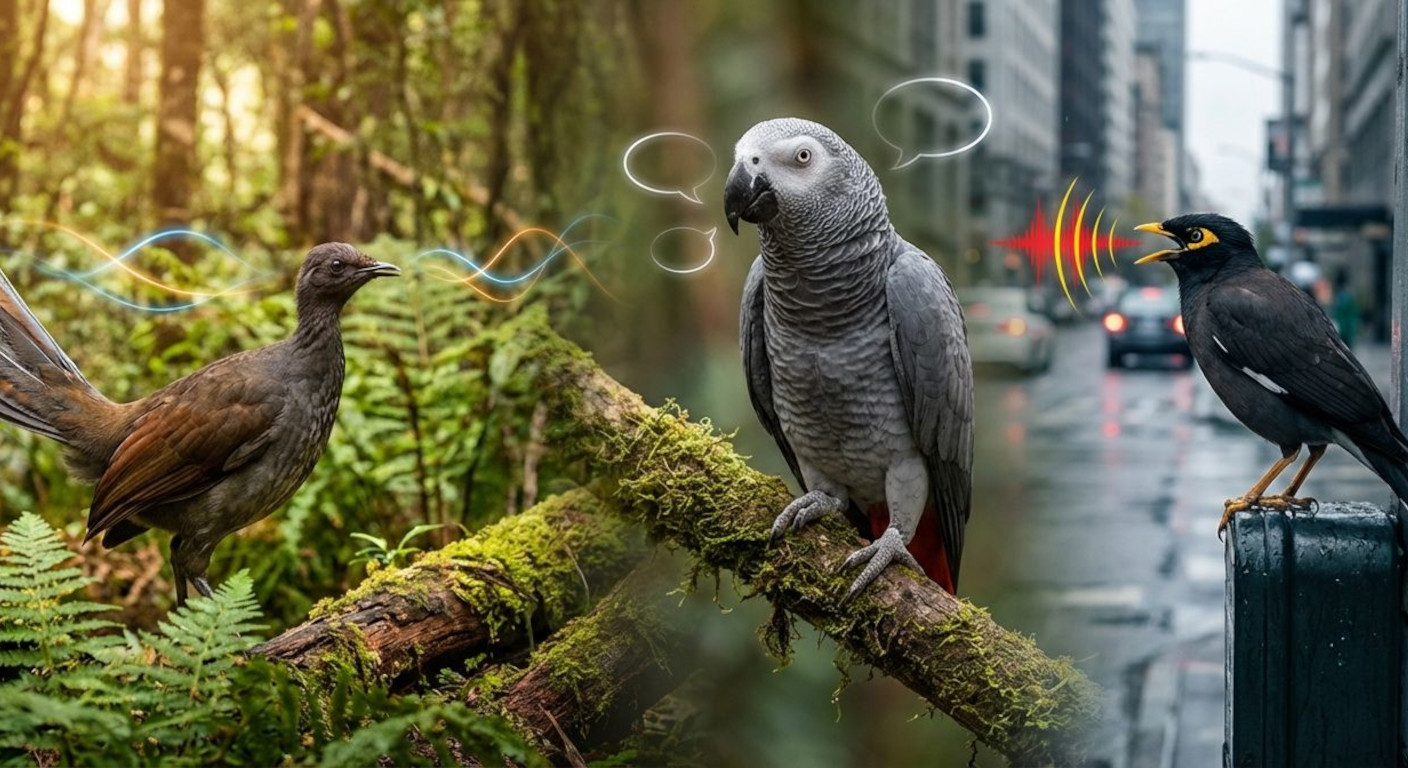
Birds that mimic sounds have captivated people for centuries: from the uncanny replication of human speech by parrots to the lyrebird’s orchestral renditions of chainsaws and camera shutters. In the next sections you’ll learn how mimicry works, which species excel at it, why they do it, and what this behavior means for cognition, communication and responsible pet ownership.
What is vocal mimicry in birds?
Vocal mimicry — sometimes called sound mimicry or acoustic imitation — is the ability of some birds to copy the sounds of other animals, mechanical noises or human speech. Mimicry is distinct from innate calls: many species learn sounds through social exposure and practice, a process known as vocal learning. Birds that mimic sounds are therefore valuable models for studying learning, memory and acoustic communication.
Key terms
- Vocal learning: the capacity to modify vocal output based on auditory experience.
- Syrinx: the avian vocal organ enabling complex sound production.
- Mimicry: copying sounds from other sources, which can be conspecifics (same species), heterospecifics (other species) or non-biological sounds.
Which species mimic sounds? Spotlight on lyrebirds, parrots and more
Not all vocal learners mimic foreign sounds, but several families are famous for it:
- Lyrebirds (Menura spp.) — especially the superb lyrebird — are legendary for imitating a wide array of environmental and anthropogenic noises with astonishing fidelity.
- Parrots (Psittaciformes) — African greys, amazons, budgerigars and cockatoos can reproduce human speech and environmental sounds and display advanced social use of vocalizations.
- Mockingbirds and thrashers (Mimidae family) — mimic multiple species’ songs as part of repertoire expansion.
- Mynas and starlings (Sturnidae) — adept at copying human sounds and city noises, common in urban environments.
- Lyrebird relatives and some passerines — while not all are as dramatic as lyrebirds, many passerines incorporate heterospecific sounds into their songs.
Each group’s mimicry has different ecological contexts and functions, which we explore below.
How do birds mimic sounds? Anatomy and learning mechanism
The syrinx: a powerful sound factory
Bird vocalizations originate in the syrinx, a specialized vocal organ at the base of the trachea. The syrinx allows some birds to produce remarkably complex and rapid frequency changes; parrots add tongue, beak and respiratory modulation to shape sounds, enabling close approximations of human speech.
Learning by listening and practice
Mimicking birds rely on auditory feedback and social exposure. Young birds often undergo a sensitive period when they memorize sounds from tutors (parents or neighbors) and later practice to match them. Species differences exist: parrots can learn throughout life, while others have more constrained learning windows.
Neural basis
Specialized brain circuits (song control nuclei) underlie vocal learning. Research shows parallels between avian vocal learning systems and mammalian speech centers — making birds that mimic sounds important models for neuroscience and linguistics.
Why do birds mimic sounds? Functions and benefits
Mimicry can serve multiple adaptive functions, often context-dependent:
- Mate attraction: Larger, more varied repertoires can signal male quality (notably in lyrebirds and some songbirds).
- Territorial defense: Mimicking neighbors or predators can confuse rivals or reinforce territorial claims.
- Social bonding: In parrots, shared vocalizations strengthen pair and group cohesion.
- Deception and predator deterrence: Some species mimic predator calls or other species to mislead competitors or predators.
- Environmental adaptation: Urban birds often replicate anthropogenic sounds, which may help them occupy novel acoustic niches.
While proximate benefits (e.g., mating success) are documented, some mimicry might be a byproduct of advanced vocal learning without direct selective advantage for every copied sound.
Comparing extremes: the lyrebird versus parrots
Superb lyrebird — the mimic maestro
The superb lyrebird (Menura novaehollandiae) is often described as the most accomplished natural mimic. Males build complex repertoires that include other birds’ songs, mammal calls and even mechanical noises. Their mimicry plays a central role during elaborate courtship displays where vocal variety enhances mating prospects.
Parrots — social mimics and conversationalists
Parrots such as the African grey (Psittacus erithacus) and budgerigar (Melopsittacus undulatus) can imitate human speech with remarkable clarity. Unlike lyrebirds, parrots use mimicry within social groups — copying flock calls and human words to bond and solicit attention. Some parrots display problem-solving skills, symbolic understanding, and the ability to map sounds to objects, revealing high cognitive complexity.
Cognitive implications: what mimicry tells us about bird intelligence
Vocal mimicry correlates with several indicators of advanced cognition:
- Social learning and cultural transmission of vocal traditions.
- Imitation as evidence of flexible behavior and auditory memory.
- Problem-solving and contextual use of sounds (especially in parrots).
Scientific studies have used mimicking species to probe learning mechanisms, neural plasticity, and the evolutionary pathways that gave rise to complex communication systems.
Are mimicking birds good pets? Which species are appropriate for owners?
Many people seek parrots specifically for their ability to talk, but owning a mimicking bird comes with responsibilities. If you are considering a pet, think beyond novelty: lifespan, social needs, noise levels and legal protections all matter.
Parrots commonly kept as pets
- Budgerigars (budgies) — small, social, relatively easier to care for and learn words/sounds.
- Cockatiels — gentle, able to mimic whistles and simple phrases.
- Amazons — excellent talkers with strong personalities; need enrichment and space.
- African grey parrots — among the most linguistically gifted; require intense social interaction and mental stimulation.
Species like lyrebirds and many wild passerines are not suitable or legal as pets and should remain in the wild. Always check local wildlife laws and adopt from reputable rescues or breeders—never purchase wild-caught birds.
Welfare and ethical notes
Parrots are long-lived and social; inadequate care leads to behavioral problems such as feather plucking and chronic stress. Prospective owners should research diet, enrichment, socialization and veterinary care. For guidance, see resources like Cornell Lab of Ornithology and animal welfare groups.
Training and encouraging natural vocal behavior
If you own or work with a mimicking bird, you can encourage healthy vocal behavior with positive methods:
- Provide a varied acoustic environment: natural bird calls, toys that produce predictable sounds, and human speech used appropriately.
- Use positive reinforcement (treats, attention) to shape desirable vocalizations.
- Allow social interaction—parrots learn most effectively through social exchange rather than passive playback alone.
Respect species-specific needs and avoid reinforcing loud, attention-seeking screams that can become problematic in home settings.
Conservation and human impact
Some species that mimic sounds are threatened by habitat loss, trapping for the pet trade and environmental change. Lyrebirds, for example, depend on forest habitats that can be fragmented by development. Urbanization also changes the acoustic environment: some birds adapt by incorporating human-made noises into their repertoires, which raises questions about long-term fitness and cultural evolution.
Supporting conservation organizations, avoiding wild-caught pets, and promoting habitat protection are practical steps for enthusiasts. See National Geographic and BirdLife International for further reading.
Curiosities and remarkable examples
- The lyrebird can chain together dozens of different mimicked sounds within a single display sequence.
- Some parrots not only mimic words but use them in context—mapping sounds to objects or requests—demonstrated in trained African greys.
- Urban starlings and mynas often imitate car alarms, mobile phone ringtones and machinery, blending natural and artificial soundscapes.
Practical tips for bird lovers and students
- Listen actively: Keep field notes about which sounds wild birds copy when observing—this can reveal social networks and habitat influences.
- Use reputable sources: For academic or care information, rely on institutions like the Cornell Lab and peer-reviewed literature.
- Consider adoption: If seeking a pet parrot, check rescue organizations before breeders.
Suggested further reading
Conclusion
Birds that mimic sounds highlight the remarkable flexibility of avian communication systems. From the lyrebird’s cinematic mimicry to a parrot’s conversational talents, these behaviors illuminate learning, sociality and adaptation. Whether you’re a student, birdwatcher or potential pet owner, understanding the science and ethics behind mimicry helps you appreciate and protect these extraordinary animals.
Curious to hear examples? Many institutions publish audio collections—explore the Cornell Lab’s audio archives or National Geographic features to listen for yourself.