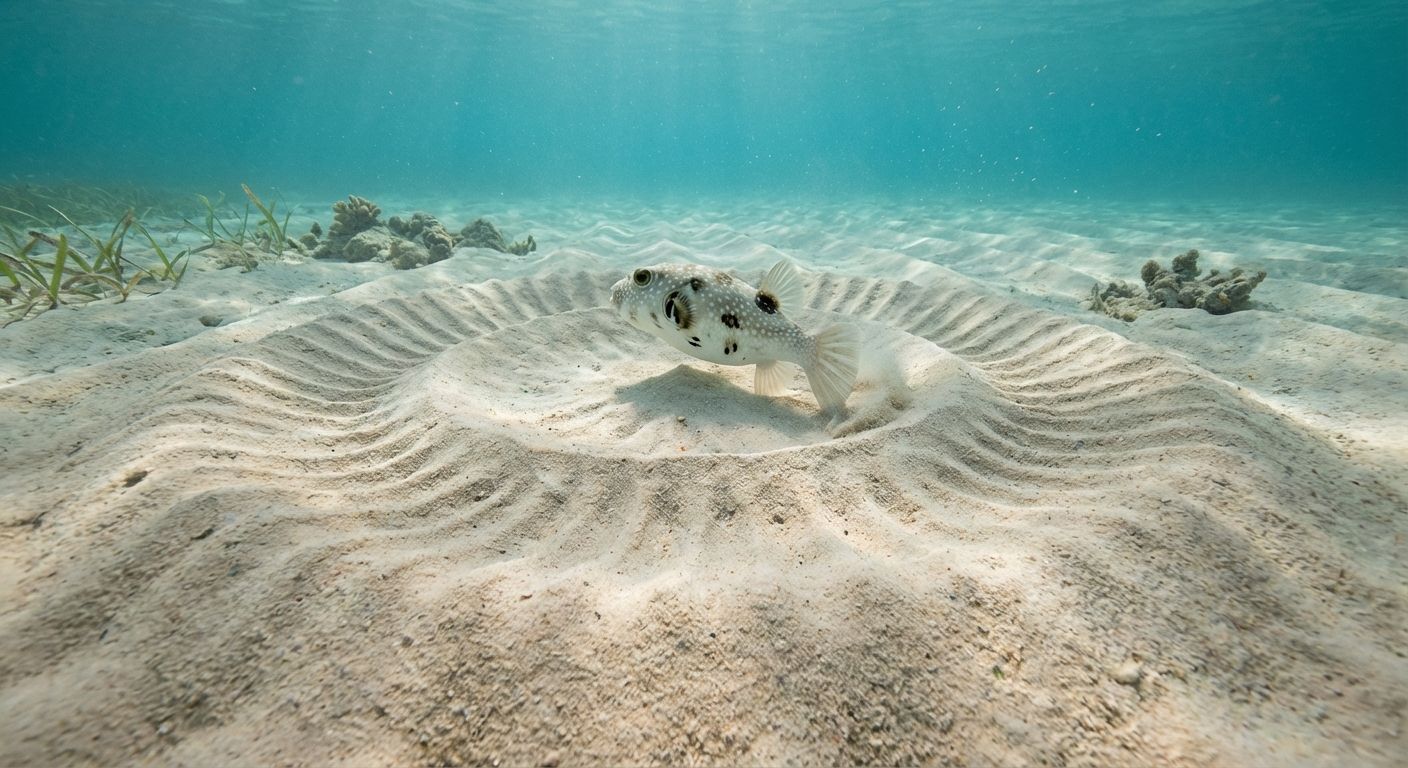
Artist fish — the phrase captures the imagination, and it is an apt label for the white-spotted pufferfish (Torquigener albomaculosus), a small marine species that creates perfectly formed concentric sand circles on the seafloor. The term artist fish appears to clarify the subject, guiding the reader into a deep dive into the behavior and biology behind the puffer’s sand sculptures.
Introduction: Why call it the “artist fish”?
The nickname artist fish comes from the male white-spotted pufferfish’s ability to carve intricate, large-scale geometric patterns in sandy seabeds. These constructions look like delicate crop circles beneath the waves — highly symmetrical, radial ridges and troughs that can reach several meters in diameter. Far from aesthetics for human viewers alone, these sand circles are functional: they are mating displays and nest sites designed to attract females and to protect eggs from currents.
Species overview: Who is the white-spotted pufferfish?
The white-spotted pufferfish (Torquigener albomaculosus) is a member of the Tetraodontidae family, commonly known as pufferfishes. Key characteristics include:
- Size: Relatively small, typically under 10–15 cm in length.
- Appearance: A pale body with distinctive white spots and subtle patterns that provide camouflage on sandy or rubble substrates.
- Defense: Like other pufferfishes, it can inflate its body when threatened and often harbors tetrodotoxin, a potent neurotoxin.
- Distribution: Found in subtropical waters of the western Pacific, notably around regions of Japan where the famous sand circles were first documented.
Behavioral marvel: How the artist fish sculpts the seafloor
The creation process is a combination of repeated, precise movements. Males excavate and sculpt the sand using their fins and bodies, forming radial ridges and valleys that radiate from a central zone. The pattern typically includes:
- Concentric rings and radial spokes that create striking symmetry.
- A central nest depression where females lay eggs.
- Fine textures and tiny grooves that may influence water flow.
Step-by-step nest construction
Observations by marine biologists and underwater videographers outline a general sequence:
- Site selection: A male selects a relatively flat sandy patch sheltered from heavy currents.
- Foundation work: Using broad tail and fin strokes, the fish digs a circular depression.
- Radial carving: The male repeatedly swims outward from the center, creating ridges and grooves by displacing sand with deliberate fin movements.
- Surface finishing: Toward the end, the male smooths or textures areas of the nest to create micro-patterns that may affect how scent and water flow reach the center.
Why so much effort? The prevailing scientific interpretation is that the structure functions as both a sexual signal and a practical nest. The size, symmetry and texture likely communicate male fitness to females, while the geometry reduces local currents and helps keep fertilized eggs sheltered.
Functions and hypotheses: What purpose do the sand circles serve?
Researchers have proposed several, non-mutually-exclusive functions for the white-spotted pufferfish’s constructions:
- Mate attraction: Females appear to prefer larger and more symmetrical nests, suggesting sexual selection plays a central role.
- Egg protection: Nest geometry may slow water flow to the center, helping delicate eggs remain in place.
- Microhabitat modification: The patterns could alter sediment characteristics and local microfauna, indirectly benefiting egg development.
- Signal of male quality: The time and energy invested send a reliable signal of vigor and parental ability.
Habitat and ecology
These pufferfish live in sandy and rubble areas of coastal seas, often at moderate depths. Typical habitat features include:
- Sandy plains and slopes
- Areas with moderate current, which the nests help to modulate
- Proximity to seagrass beds or reefs which may provide food and shelter
Understanding the habitat is essential for conservation: changes in sedimentation, coastal development, and bottom trawling can all disrupt the delicate conditions these fish need to build nests.
Reproduction and life cycle
Reproductive behavior centers around the nest. Key points include:
- Male display and courtship: Males actively construct and maintain nests, performing courtship behaviors to draw females.
- Egg-laying: Females inspect nests and deposit eggs in the central depression if convinced by the nest quality and male performance.
- Fertilization and care: Fertilization is external; the male may guard or maintain nest integrity for a period after eggs are laid.
Scientific significance and studies
The discovery of the white-spotted pufferfish’s geometric nests captivated both scientists and the public because it raises questions about cognition, instinctual artistry and sexual selection. For further reading, see the species page on Wikipedia and summaries in popular outlets such as National Geographic (search for white-spotted pufferfish articles).
Scientific research suggests that while the behavior is largely instinctive, the execution — size, symmetry, and fine detail — likely varies with male fitness and experience. Studies in animal signaling and sexual selection provide useful theoretical frameworks for interpreting the nests as a form of extended phenotype: physical traits constructed by the organism that affect reproductive success.
Curiosities and notable facts
- Large scale: Some nests measure several meters across, far larger than the fish itself.
- Seasonality: Nest-building is typically seasonal and linked to mating cycles.
- Convergent interest: The nests have attracted attention from art enthusiasts, ecologists and filmmakers, showing how natural behaviors can bridge science and culture.
- Unique mechanics: The fish uses primarily fin and body movements rather than digging with mouthparts — a testament to fine motor control.
Conservation considerations
Although the white-spotted pufferfish is not currently at the center of major conservation campaigns, its reliance on undisturbed sandy habitats means it is vulnerable to:
- Habitat degradation from coastal development and dredging.
- Bottom-trawling fisheries that disrupt benthic substrates.
- Pollution and sedimentation changes that alter the seafloor’s suitability for nest-building.
Protecting areas of sandy seabed and limiting destructive fishing practices can help preserve the behavioral ecology of this remarkable species. For policy-oriented readers, resources on marine protected areas from organizations like the IUCN may provide useful context.
How to observe the artist fish responsibly
If you are a diver or snorkeler hoping to view these sand circles in the wild, consider these guidelines to minimize impact:
- Keep a respectful distance and avoid touching nests.
- Avoid stirring up sediment that might obscure or damage patterns.
- Use experienced local guides who understand seasonal behavior and protected areas.
These simple steps help ensure that the male can complete his artistic courtship without disturbance.
Frequently asked questions (FAQ)
Is the white-spotted pufferfish dangerous?
In general, pufferfishes contain toxins like tetrodotoxin, which can be dangerous if consumed. They are not aggressive toward divers; the greater concern is human consumption or handling.
Do other fish make similar structures?
While many animals modify their environment (e.g., birds’ nests, fish that build nests using pebbles), the scale and symmetry of the white-spotted puffer’s constructions are unusual among fishes, making them a standout example of environmental modification for reproductive purposes.
Can these patterns be considered art?
Whether non-human constructions qualify as “art” depends on how one defines art. From a scientific standpoint, the nests are best understood as evolved behaviors with reproductive functions. From a cultural perspective, calling the males “artists” helps communicate the wonder and complexity of animal behavior to the public.
Conclusion
The white-spotted pufferfish — the artist fish — offers a striking example of how behavior, environment and evolution intersect to produce astonishing natural phenomena. Its geometric sand circles are not merely decorative: they are purposeful constructions shaped by sexual selection and environmental pressures. For lovers of marine life, students and curious readers, these nests provide a window into the creativity of nature and underscore the importance of conserving delicate seafloor habitats so that future generations can continue to marvel at these underwater masterpieces.
Further reading: Explore more about this species on Wikipedia and search for recent marine biology papers on nest-building fish in journals such as Scientific Reports and Behavioral Ecology.