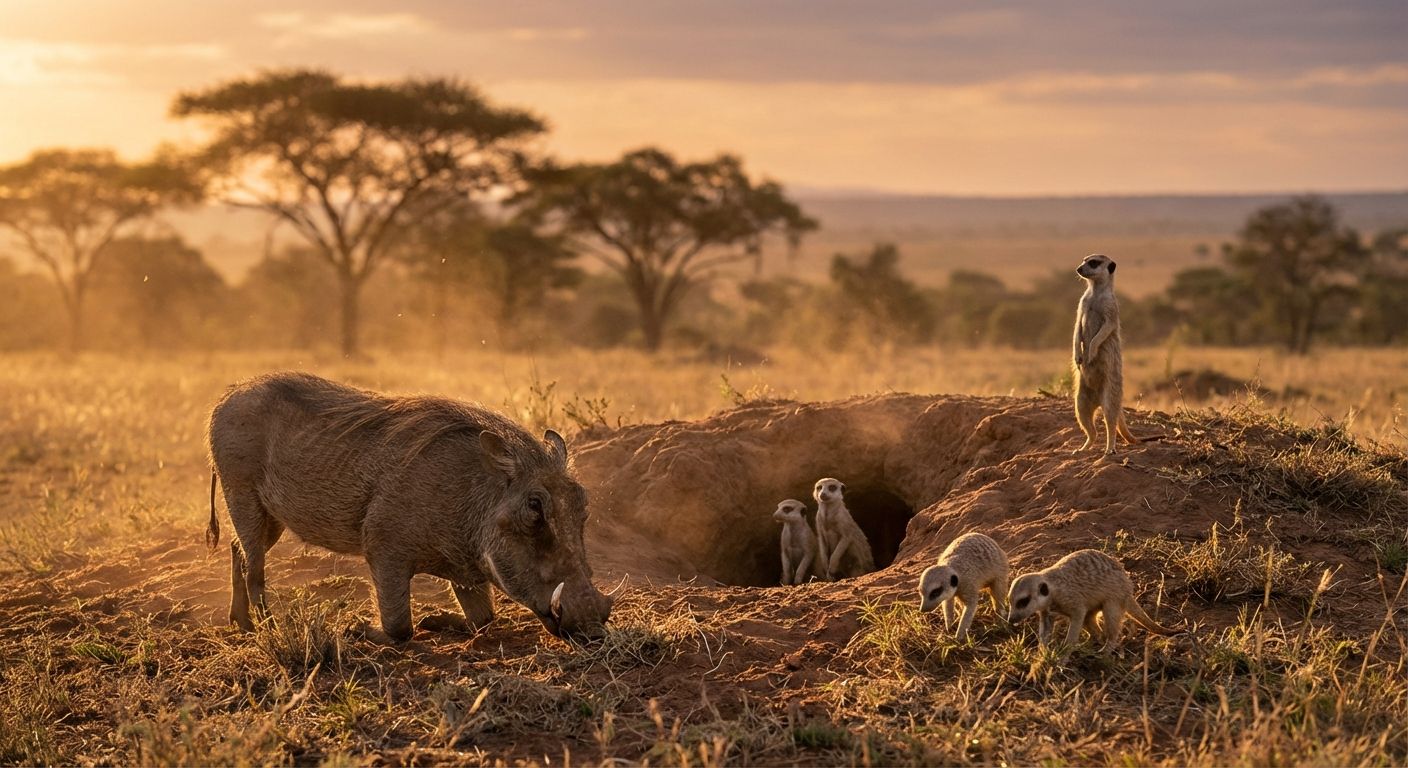
The ecological relationship between warthog and suricata is an intriguing example of how species with different sizes, diets and behaviors can coexist in the same landscape. In many African savannas and dry grasslands, these interactions—direct and indirect—shape local community dynamics and affect predator-prey relationships, vegetation, and nutrient cycles. This article examines how warthog and suricata interact, what benefits or conflicts arise, and why understanding this relationship matters for ecology and conservation.
Introduction: Who are these animals?
Warthogs (Phacochoerus africanus) are medium-sized wild pigs common across sub-Saharan Africa. They are primarily grazers and rooters, feeding on grasses, bulbs and occasionally carrion. Suricatas (Suricata suricatta), often called meerkats, are small, highly social mongooses that live in cooperative groups and forage for insects, small vertebrates and plant matter. Both species favour open habitats with accessible burrows and good visibility—features that help them avoid predators.
Shared habitat and spatial overlap
Spatial overlap is the first prerequisite for interaction. Warthog and suricata commonly occur in:
- Open savannas and short-grass plains
- Dry riverbeds and floodplains
- Areas with loose soil suitable for digging
Warthogs often maintain and enlarge burrows originally created by other animals (e.g., aardvarks) and can leave abandoned burrows around which suricata colonies establish themselves. This physical proximity increases the likelihood of repeated interactions.
Types of interactions
1. Commensalism and shelter use
One of the clearest relationships is a form of commensalism. Warthogs dig and maintain burrows that provide shelter not only for themselves but also for other species. Suricatas, which rely on burrow systems for refuge from predators and for rearing young, can benefit from warthog activity without significantly affecting the warthog. Observations show suricata groups sometimes occupy burrow complexes near or adjacent to warthog sleeping or grazing areas, gaining quick access to shelter.
2. Foraging interactions and indirect competition
Diet overlap between warthogs and suricatas is limited but not absent. While warthogs primarily graze and dig for roots and bulbs, suricatas hunt small invertebrates and vertebrates. Indirect competition can occur when both disturb soil and vegetation, temporarily changing prey availability. For example:
- Warthog rooting loosens soil and exposes insects or larvae that suricatas can then exploit.
- Conversely, heavy warthog grazing may reduce plant cover, altering insect communities and affecting suricata foraging success.
Overall, these effects tend to be subtle and often benefit the suricatas more by increasing access to prey—another example of a facilitative interaction.
3. Anti-predator dynamics and vigilance
Predation pressure influences how species interact. Both warthogs and suricatas are prey for large carnivores (lion, leopard, cheetah) and birds of prey. Their vigilance behaviors can indirectly complement each other. Warthogs, being larger, are less nimble but have good eyesight and can detect distant threats; suricatas maintain sentinels that watch for danger while group members forage. This multi-species vigilance can create a mosaic of safer microhabitats where each species benefits from the alertness of the other.
4. Disease and parasite considerations
Close ecological association can facilitate parasite transmission or shared exposure to pathogens. While warthogs and suricatas host distinct parasite communities, overlapping use of burrows and feeding grounds increases the chance of encounter with ticks, fleas, or helminth stages in soil. Monitoring disease dynamics is important, especially where habitat alteration forces higher densities of hosts.
Functional roles and ecosystem impact
Both species act as ecosystem engineers in different ways:
- Warthogs influence soil turnover, seedbed preparation and vegetation structure through rooting and grazing.
- Suricatas affect invertebrate populations and contribute to soil aeration by digging for prey.
Together, the combined digging activities can enhance soil heterogeneity, promote nutrient cycling and create microhabitats used by plants, invertebrates and small vertebrates. Such positive feedbacks increase local biodiversity and resilience of the savanna patch.
Behavioral ecology: daily rhythms and social structure
Differences in activity patterns reduce direct conflict. Warthogs often feed during the cooler parts of the day and rest in burrows at peak heat; suricatas are diurnal but coordinate foraging in shifts, with sentinels. These differences allow temporal partitioning of resource use. Social structures also differ: warthogs may be solitary or form small sounders, while suricatas live in tight-knit cooperative groups. The latter’s social vigilance and cooperative defense can indirectly protect nearby animals by making predators more wary.
Case studies and observations
Field observations from several African reserves and research studies have documented recurring patterns:
- Suricata colonies near warthog wallows or burrows show higher refuge access during high-risk periods.
- Warthog foraging paths often reveal increased insect activity, which suricatas exploit subsequently.
For more detailed species accounts and conservation status, consult reputable sources such as the IUCN Red List and species profiles on National Geographic.
Human impacts and conservation implications
Habitat loss, agricultural expansion and hunting can disrupt the delicate balance between coexisting species. When burrows are destroyed or predator dynamics change, the availability of shelter and the network of interactions can collapse, leading to reduced local biodiversity. Conservation strategies that maintain habitat heterogeneity, protect burrow-bearing soils, and monitor predator populations help preserve the beneficial interactions between species like warthog and suricata.
Interesting parallels with popular culture
The dynamic between a large, slow grazer and a small, vigilant forager evokes the famous duo from The Lion King: Pumbaa (a warthog-like figure) and Timon (a meerkat/suricata). While the film simplifies animal behavior for storytelling, the real-world relationship carries kernels of truth: sometimes different species form loose, beneficial associations based on shelter use and mutual awareness. Mentioning this cultural reference can help readers connect with the science—while clarifying that nature is more complex than animated portrayals.
Practical takeaways and study questions
Key points to remember:
- Warthog and suricata coexist primarily through spatial overlap and complementary behaviors rather than direct cooperation.
- Interactions include commensal shelter use, facilitation of prey access, and shared vigilance benefits.
- Combined digging and foraging activities contribute positively to soil and biodiversity.
- Human-driven habitat change can disrupt these interactions—conservation should focus on habitat heterogeneity and burrow protection.
Suggested questions for further study or classroom discussion:
- How does warthog grazing intensity affect insect abundance and suricata diet composition?
- What are the disease transmission risks associated with shared burrow use?
- Can suricata sentinels measurably reduce predation risk for nearby species?
References and suggested reading
- IUCN Red List species pages: https://www.iucnredlist.org/
- National Geographic animal profiles: https://www.nationalgeographic.com/animals
- Field studies on meerkat ecology and cooperative behavior (e.g., works by Tim Clutton-Brock and colleagues)
Conclusion
The relationship between warthog and suricata illustrates how species with different niches can create complementary interactions that benefit local ecosystems. While not a tight mutualism, the combination of shelter provision, foraging facilitation and shared vigilance shows that coexistence often involves subtle, context-dependent processes. Appreciating these dynamics deepens our understanding of savanna ecology and highlights the importance of conserving habitat complexity so that such interspecific relationships persist.