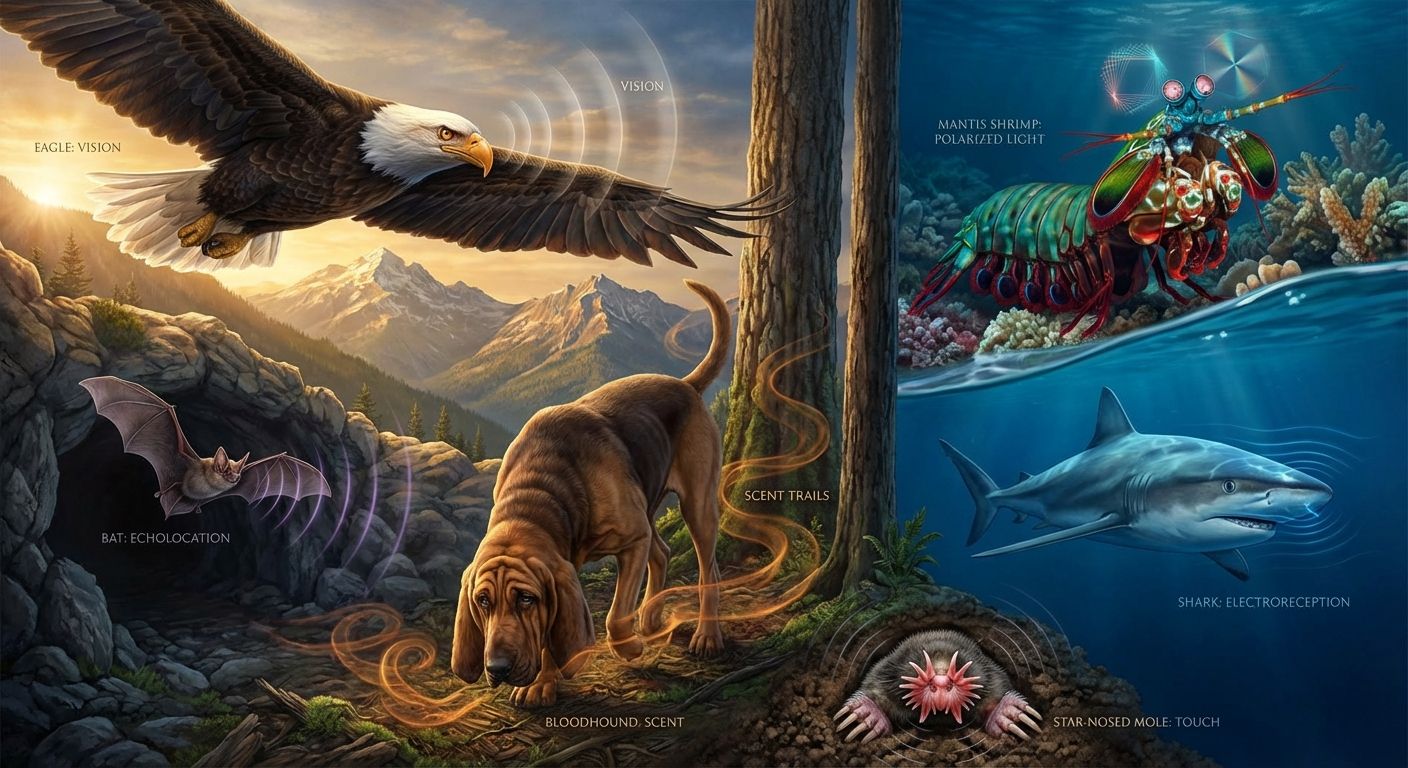
Keen senses are nature’s tools for survival. In the wild, exceptional sensory abilities can mean the difference between life and death—finding food, avoiding predators, navigating, and selecting mates all depend on sensory input. This article examines the animals considered to have the most developed sensory systems, explains how those systems work, and shows how they contribute to survival and adaptation.
Why keen senses matter
Animals live in complex environments where information is continuous, noisy, and often incomplete. Evolution has produced a wide variety of sensory specializations—enhanced vision, acute hearing, superior olfaction (smell), electroreception, mechanoreception (touch), and echolocation—each tuned to a species’ ecological niche. Keen senses improve:
- Foraging efficiency: detect prey at greater distances or through obstacles.
- Predator avoidance: early detection and accurate threat assessment.
- Navigation: orienting in featureless environments (ocean, night, dense forest).
- Communication and reproduction: recognizing mates, rivals, territory markers.
How sensory systems work (a brief primer)
Each sense relies on specialized organs and neural processing. A quick overview:
Vision
Vision depends on the eye’s anatomy (photoreceptor types, pupil shape, retina density) and brain regions that process visual information. Species with high cone density or additional photoreceptor types (e.g., ultraviolet) can detect finer detail or different light wavelengths.
Hearing
Hearing is shaped by ear morphology and neural tuning. Some animals hear ultrasonic or infrasonic frequencies, providing access to sounds humans cannot detect.
Olfaction (smell)
Olfaction depends on receptor diversity and the size of olfactory brain regions. Animals with millions of receptors can discriminate subtle scent traces and follow complex odor plumes.
Echolocation
Echolocation uses sound emission and returning echoes to build a spatial map of the environment. Animals that use echolocation have highly precise timing and auditory processing to interpret echo delays and frequency shifts.
Electroreception and mechanoreception
Electroreception detects electrical fields generated by muscle activity or the environment; mechanoreception senses pressure changes, water movement, or touch with extraordinary sensitivity.
Animals with the keenest senses and how those senses aid survival
Below are well-studied examples across sensory modalities. Each profile explains the mechanism and the ecological advantage.
1. Birds of prey (eagles, hawks) — Vision
Eagles and hawks possess some of the sharpest vision in the animal kingdom. Their eyes have extremely high retinal cone density and a deep fovea, allowing them to spot small prey from great distances. Some species have binocular overlap for depth perception and can detect ultraviolet light, aiding in contrast detection.
Survival advantages: spot distant prey, judge depth during stoops (dives), and forage efficiently across wide territories. (See National Geographic on raptor vision: https://www.nationalgeographic.com/animals/birds/facts/bald-eagle)
2. Bats — Echolocation
Bats emit ultrasonic calls and listen to returning echoes to navigate and capture evasive insects at night. Their auditory systems can detect microsecond timing differences, enabling them to build detailed spatial maps even in complete darkness.
Survival advantages: night-time foraging with reduced competition, precise prey capture in cluttered environments, and obstacle avoidance. (BBC overview of bat echolocation: https://www.bbc.co.uk/news/science-environment-)
3. Dogs and bloodhounds — Olfaction
Dogs, especially breeds like bloodhounds, have vastly expanded olfactory epithelium and receptor diversity. Their brains dedicate large areas to processing scent. Dogs can follow scent trails days old and detect trace chemical cues at parts-per-trillion levels.
Survival advantages (wild canids): track prey or conspecifics, find food caches, detect predators. In human contexts, trained dogs locate missing persons, contraband, or disease markers. (Smithsonian on canine scent: https://www.si.edu/)
4. Mantis shrimp — Vision (color and polarization)
The mantis shrimp has one of the most complex visual systems known: dozens of photoreceptor types for color and polarization sensitivity. Their eyes can resolve subtle spectral differences and polarized light patterns underwater.
Survival advantages: detect prey and predators against complex underwater backgrounds, communicate using polarized signals, and select mates based on subtle color cues. (Nature coverage on mantis shrimp vision: https://www.nature.com/)
5. Sharks (and some fish) — Electroreception
Sharks and rays possess ampullae of Lorenzini, organs that sense minute electrical fields generated by muscle contractions of prey and by Earth’s magnetic fields. This sense functions in low-visibility conditions and assists in locating buried or camouflaged prey.
Survival advantages: hunting hidden prey, navigating using geomagnetic cues, and locating prey at close range even when visual cues are limited. (Encyclopaedia Britannica: https://www.britannica.com/animal/shark)
6. Owls — Hearing
Owls have asymmetrically placed ears and facial discs that funnel sound to the auditory canals. They can detect tiny differences in arrival time and intensity, enabling them to locate prey under snow or vegetation with pinpoint accuracy.
Survival advantages: nocturnal hunting with high success rates, detection of concealed prey, and silent flight to avoid alerting targets. (National Audubon Society resources: https://www.audubon.org/)
7. Star-nosed mole — Touch
The star-nosed mole has a star-shaped nasal appendage packed with thousands of Eimer’s organs—specialized mechanoreceptors. This structure samples tactile information extremely fast, allowing the mole to identify prey in milliseconds.
Survival advantages: rapid foraging underground and in muddy wetlands where vision is limited; immediate identification of edible prey. (Journal articles on Eimer’s organs: https://www.journals.uchicago.edu/)
8. Bees — Ultraviolet vision
Bees see ultraviolet patterns on flowers invisible to humans. These patterns guide bees to nectar and pollen and facilitate efficient pollination partnerships between plants and pollinators.
Survival advantages: better foraging efficiency, energy savings, and improved navigation using floral and sky polarization cues. (Royal Society or plant-pollinator research summaries)
Comparative insights: Why different senses prevail in different niches
Sensory evolution is shaped by environment and lifestyle. Clear patterns emerge:
- Open, daylight habitats favor vision (raptors, many ungulates).
- Nocturnal or cluttered habitats favor hearing and echolocation (owls, bats).
- Dense forests and complex scent landscapes favor olfaction (canids, many mammals).
- Aquatic habitats often favor electroreception, lateral line mechanoreception, and polarization vision (sharks, fish, mantis shrimp).
Animals rarely rely on a single sense; instead, they integrate multisensory information—called sensory fusion—to increase accuracy and reduce uncertainty. For instance, a hunting owl uses both vision and hearing; a dolphin combines vision with echolocation.
Human perspective: What we can learn from keen senses
Studying animal senses has practical applications: improving sonar and radar, developing electronic noses for medical diagnostics and security, and designing robots that navigate like animals in complex terrain. Biomimicry draws inspiration from these natural solutions to solve engineering problems.
Further reading and reliable sources
For deeper study, consult these reputable resources:
- National Geographic — animal profiles and sensory features: https://www.nationalgeographic.com/animals
- Encyclopaedia Britannica — scientific overviews: https://www.britannica.com
- Primary research in journals such as Nature and Science (search for sensory ecology and neuroethology).
Conclusion
Keen senses are among the most remarkable outcomes of evolution, finely tuned to each species’ ecological challenges. Whether it’s a mantis shrimp detecting polarized light, a bat painting a sonic map with echoes, or a bloodhound following a faint trail, these sensory abilities provide clear survival advantages—locating food, avoiding danger, navigating complex environments, and communicating. Understanding these systems enriches our appreciation of biodiversity and inspires technological innovations rooted in nature.