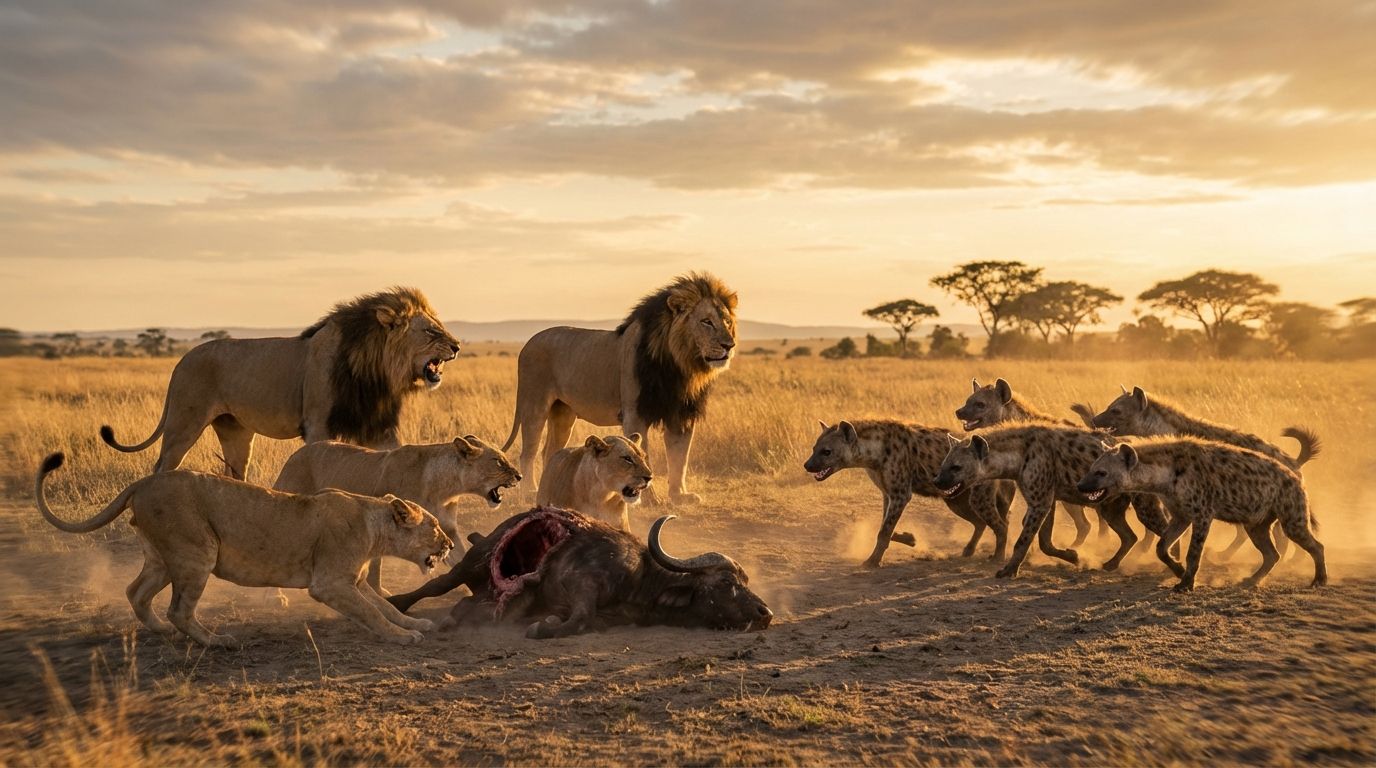
Rivalry between lions and hyenas is one of the most dramatic and studied competitive relationships in African ecosystems. This dynamic shapes not only how these predators hunt and scavenge, but also how they arrange their social lives and territories. In this article we explore the ecology, behavior and fascinating curiosities behind their clashes, backed by observations and research.
Why this rivalry matters
The interaction between lions (Panthera leo) and spotted hyenas (Crocuta crocuta) is a prime example of interspecific competition where overlapping diets and habitat use create repeated conflicts. These interactions affect population dynamics, prey selection, carcass utilization and even the structure of entire savannah communities. Understanding this rivalry helps explain broader ecological processes such as trophic cascades, resource partitioning and predator coexistence.
Key players and social structure
Lions: prides, leadership and hunting roles
Lions are social felids that hunt in prides—family groups usually made up of related females, their cubs, and a coalition of males. Female cooperation is central to hunting success and cub rearing. Lions rely on ambush and strength, often targeting large ungulates. Male coalitions defend territory and access to females, influencing pride stability and interactions with rival predators.
Spotted hyenas: clans, rank and intelligence
Spotted hyenas live in complex matriarchal clans that can outnumber lion prides. High social intelligence, cooperative hunting, and flexible foraging strategies (both hunting and scavenging) give hyenas advantages in certain contexts. Female hyenas are typically dominant over males, and linear dominance hierarchies affect access to food and reproductive opportunities.
Hunting strategies and resource competition
Although both species are apex predators, their approaches to securing food differ:
- Lions often use stealth, group coordination, and a burst of speed to take down large prey like buffalos, zebras and wildebeest.
- Hyenas excel as endurance hunters and opportunistic feeders; they can pursue prey for longer distances and are highly successful at scavenging and stealing kills.
Competition arises when both target the same prey or when hyenas attempt to kleptoparasitize (steal) kills from lions. In many cases, hyenas employ numbers, persistence, and vocal coordination to harass lions and force abandonment of a carcass—especially when a large clan outnumbers a pride.
Scenarios of interaction
- Stealing kills: Hyenas may harass lionesses to drag them away from a carcass; lions retaliate with aggression and postural displays.
- Mutual avoidance: Where populations are dense, temporal partitioning occurs—lions and hyenas adjust activity patterns to reduce direct conflict.
- Direct combat: Fights can be brutal and sometimes fatal; male lions with large manes and strong jaws can kill hyenas, while coordinated hyena attacks can overwhelm lone or small groups of lions.
Behavioral adaptations and strategies
Both species display adaptations that specifically address interspecific competition:
Hyena strategies
- Clan cohesion: Hyenas call with distinctive whoops to recruit clan members to a food source or to mob competitors.
- Endurance hunting: Hyenas can run longer distances, which allows them to catch certain prey and persist in pursuing or locating carcasses.
- Stealth and opportunism: Hyenas exploit moments when lions are weakened, outnumbered or distracted (e.g., during a pride’s resting period).
Lion strategies
- Strength and size: Adult male lions can intimidate and kill hyenas, especially when defending a pride or a kill.
- Group defense: Pride members often band together to defend food; female coalitions are critical when multiple hyenas approach.
- Strategic feeding: Lions may cache and consume carcasses rapidly to reduce the window in which hyenas can steal them.
Ecological and evolutionary implications
The rivalry has long-term consequences for both species and their ecosystems. For example:
- Population regulation: Direct mortality from conflicts and indirect effects on prey availability influence population trajectories.
- Behavioral evolution: Selection favors traits like enhanced group cooperation in both species and increased vigilance or concealment strategies.
- Resource partitioning: Temporal, spatial and dietary adjustments reduce niche overlap and allow coexistence.
Fascinating curiosities and lesser-known facts
- Vocal warfare: Hyenas possess a wide vocal repertoire used for recruitment and intimidation; lions also use roars and grunts to signal presence and summon pride members.
- Intelligence vs. brute force: Hyenas rank among the most intelligent carnivores—studies show problem-solving abilities comparable to primates, which helps them exploit complex opportunities against lions.
- Coalition dynamics: In some regions, hyena clans and lion prides develop long-term spatial rivalries where border encounters are routine and predictable.
- Mutual benefit scenarios: Although often antagonistic, there are rare cases where the presence of both species can indirectly aid carcass detection for scavengers and speed nutrient cycling.
Case studies and research highlights
Field studies across East and Southern Africa provide rich documentation of these interactions. For accessible overviews, consult resources like National Geographic and peer-reviewed studies such as publications in Journal of Mammalogy or ScienceDirect. Key findings include:
- Hyena group size strongly predicts success at stealing from lions; larger clans displace smaller prides more often.
- Lion prides adjust hunting times and carcass handling tactics in areas with high hyena densities.
- Territorial boundaries, water availability and prey abundance modulate the frequency of deadly encounters.
For students and researchers, long-term datasets from reserves like the Serengeti and Kruger National Park are invaluable. Consider reviewing conservation reports and ecological papers to deepen empirical understanding.
Practical tips for observers and photographers
If you’re a wildlife enthusiast observing lion-hyena dynamics in the field:
- Keep a safe distance; both species can behave unpredictably around food.
- Use binoculars and long lenses to document interactions without disturbing animals.
- Note time of day, group sizes, and any vocalizations—these details are critical for behavioral records.
Conservation considerations
Human pressures—habitat loss, prey depletion and direct persecution—intensify competition between lions and hyenas by shrinking resources. Protecting large landscapes, maintaining prey populations and mitigating human-wildlife conflict are essential to preserve natural balance. Conservation strategies that consider interspecific competition can improve outcomes for both species and the ecosystems they regulate.
Takeaways
The rivalry between lions and hyenas is not merely a spectacle; it is a window into complex ecological relationships shaped by evolution, behavior and environment. Both species are highly adapted competitors: lions with power and cooperative ambush tactics, hyenas with intelligence, stamina, and social coordination. Their ongoing contests highlight how apex predators coexist through a mixture of conflict, avoidance, and adaptation.
For readers keen on digging deeper, consult the external links above and explore long-term field studies. Observing these dynamics responsibly in the wild offers powerful lessons about resilience, competition, and the delicate balance of savannah ecosystems.