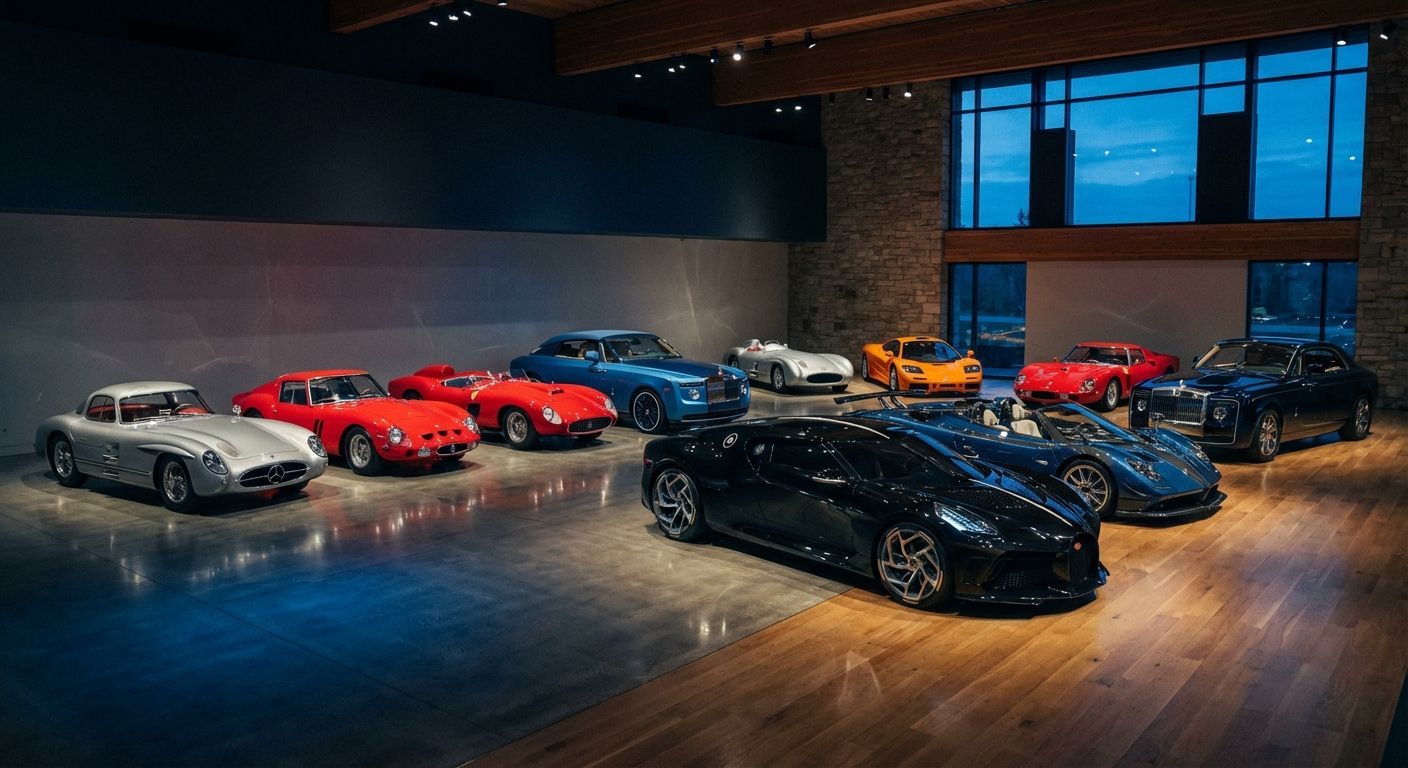
If you follow expensive cars, you know that price is only part of the story: provenance, rarity and cultural impact matter as much as speed. This article walks through the ten most expensive cars known on the market and at auction, explaining approximate values, exclusivity, performance figures and key pros and cons for collectors and enthusiasts.
How we compiled this list
To assemble this ranking we prioritized verified auction results and well-documented private sales reported by reputable outlets (e.g., Reuters, Bugatti, RM Sotheby’s). Prices are shown as approximate values in USD or euros where the sale was reported. Note that the market for expensive cars changes with provenance, restoration and economic conditions, so ranking can shift over time.
1. 1955 Mercedes‑Benz 300 SLR Uhlenhaut Coupe — approx. €135 million (~$142M)
Price & Sale: In 2022 Mercedes reported a private sale of the legendary Uhlenhaut Coupe for about €135 million, making it the most expensive car ever sold publicly or through an auction-like mechanism. (Reuters).
History: Built for Mercedes’ chief engineer Rudolf Uhlenhaut, the 300 SLR combined cutting-edge racing technology with coachbuilt bodywork. It is essentially a road-legal version of a dominant W196 Grand Prix car and carries immense historical value as a rare factory-owned prototype.
Performance: Lightweight construction and a high-strung straight‑8 racing engine gave the car race-level performance for the 1950s. It remains a symbol of post-war engineering excellence.
Pros & Cons:
- Pros: Unrivaled historical importance, museum-quality provenance, extreme rarity.
- Cons: Not a practical drive, astronomical insurance and storage costs, near-impossible to purchase on the open market.
2. Ferrari 250 GTO (1962–1964 variants) — valuations up to ~$70 million+
Price & Sale: The Ferrari 250 GTO is often cited as the most valuable classic; private transactions and valuations have placed some examples near or above the $60–70M mark. Hagerty and market specialists frequently value top-condition 250 GTOs in that range.
History: Built between 1962 and 1964 for homologation into GT racing, the 250 GTO paired a beautiful Pininfarina/Scaglietti body with a potent V12 and a successful competition record. Its scarcity and racing heritage made it a blue-chip collector asset.
Performance: For its era the car delivered exceptional power-to-weight and agile handling, engineered for endurance racing.
Pros & Cons:
- Pros: Unmatched pedigree, excellent long-term value retention, highly collectible.
- Cons: Very limited supply, extreme purchase barriers, costs for maintenance and restoration are very high.
3. 1957 Ferrari 335 S Spider Scaglietti — approx. $35–40 million
Price & Sale: Exemplars of the 335 S have sold at major auctions for the mid‑to‑high tens of millions; RM Sotheby’s and other top houses have handled headline sales.
History: A direct descendant of Ferrari’s 1950s racing program, the 335 S was built for competition and driven by legends. Its aluminum coachwork and big-displacement V12 make it both fast and a prized historic artifact.
Performance: Large-displacement V12, light coachbuilt body, and racing-tuned components delivered top speed and straight-line performance that were exceptional for the era.
Pros & Cons:
- Pros: Strong racing heritage, striking design, excellent investment narrative.
- Cons: Extremely expensive to maintain, rare spares, limited opportunities to drive at speed safely.
4. Rolls‑Royce Boat Tail — approx. $25–30 million (commissioned modern coachbuilt)
Price & Sale: The Rolls‑Royce Boat Tail, unveiled as a bespoke coachbuilt commission, reportedly cost each client in the high tens of millions — estimates typically center around $25–30M per vehicle.
History: A modern bespoke exercise that channels coachbuilding traditions, Boat Tail was created for ultra-high-net-worth clients with individualized finishes and engineering details. Unlike classic auction cars, value derives from exclusivity and contemporary luxury.
Performance & Features: Rolls‑Royce focuses on ride, refinement and custom features rather than outright track performance; Boat Tail includes unique luxury amenities tailored to owners’ lifestyles.
Pros & Cons:
- Pros: Ultimate personalization, extremely limited production, contemporary luxury features.
- Cons: Dependent on brand prestige and client tastes, high running and customization costs, limited resale comparables.
5. 1954 Mercedes‑Benz W196 — approx. $29–30 million
Price & Sale: The W196, the Grand Prix car driven by Juan Manuel Fangio, has achieved auction results near $29–30M in top-condition examples.
History: Mercedes’ post‑war re-entry into Grand Prix racing produced the W196, notable for fuel-injection, desmodromic valve trains and advanced aerodynamics. Its rarity and storied racing success make it a collectors’ favorite.
Performance: Purpose-built for racing with cutting-edge tech of the 1950s; historically significant for motorsport development.
Pros & Cons:
- Pros: Iconic racing provenance, engineering milestones, highly desirable to museums and collectors.
- Cons: Fragile vintage race components, limited use as a road car, immense conservation costs.
6. McLaren F1 — approx. $20–25 million
Price & Sale: The McLaren F1 has repeatedly achieved auction and private-sale prices in the high teens to low twenties of millions. Its status as an engineering milestone keeps demand strong.
History: Launched in 1992 as the ultimate driver’s car, the McLaren F1 combined a central driving position, a naturally aspirated BMW V12 and a carbon-fiber monocoque. It set records and inspired a generation of hypercars.
Performance: At launch it was the fastest production car in the world; timeless chassis balance and lightweight engineering still reward driving enthusiasts.
Pros & Cons:
- Pros: Driver-focused layout, legendary performance, collectible modern classic.
- Cons: Aging mechanical systems require expert upkeep; parts and specialists are rare and costly.
7. Bugatti La Voiture Noire — approx. €11 million + taxes (reported ~$18–20 million)
Price & Sale: Unveiled in 2019 as a one‑off, Bugatti priced La Voiture Noire in the tens of millions (reports commonly quote prices around €11M before taxes, with effective client prices approaching $18–20M). (Bugatti).
History: La Voiture Noire was conceived as a modern reinterpretation of Jean Bugatti’s lost Type 57SC Atlantic — a one-off commissioned by a private client and presented as the ultimate expression of Bugatti craftsmanship.
Performance & Features: Based on Bugatti Chiron architecture with the brand’s quad-turbo W16, the car blends top‑end performance with coachbuilt luxury and unique styling cues.
Pros & Cons:
- Pros: Absolute exclusivity, modern hypercar performance, high brand prestige.
- Cons: Extremely limited comparables on resale, maintenance complexity and high running costs.
8. Pagani Zonda HP Barchetta — approx. $15–17.5 million
Price & Sale: The Zonda HP Barchetta, an ultra-limited Pagani creation, has been reported with valuations and sale prices in the mid‑teens of millions.
History: Pagani’s Zonda series has long pushed artisanal hypercar design and carbon‑composite expertise. The HP Barchetta exemplifies extremity: a lightweight, bespoke track-focused machine with unique bodywork and limited units.
Performance: High‑revving V12 power coupled with meticulous chassis tuning makes for exceptional on‑track performance for such bespoke cars.
Pros & Cons:
- Pros: Collector desirability, track-capable performance, strong brand cachet among enthusiasts.
- Cons: Ride usability limited, servicing restricted to specialists, very high upkeep costs.
9. Ferrari 250 Testa Rossa (late 1950s) — approx. $10–16 million (top examples higher)
Price & Sale: Depending on chassis, provenance and race history, 250 Testa Rossas have sold in the low tens of millions, with marquee examples commanding significantly more.
History: The Testa Rossa was built for endurance racing; its name (“red head”) refers to the painted cam covers. It earned remarkable victories and became one of Ferrari’s most iconic testaments to competition pedigree.
Performance: Classic V12 power, lightweight coachwork and race-focused tuning made it competitive in endurance events globally.
Pros & Cons:
- Pros: Deep motorsport connection, beautiful coachwork, strong collector demand.
- Cons: Restoration authenticity is expensive, parts scarcity, limited road practicality.
10. Rolls‑Royce Sweptail — approx. $12–13 million
Price & Sale: Commissioned and delivered as an exclusive one‑off, Sweptail’s reported cost places it among the most expensive modern cars, with estimates around $12–13M.
History: Sweptail is a bespoke creation that draws stylistic cues from classic coachbuilt Rolls‑Royces and high-end yachts. Crafted for an individual client, it demonstrated Rolls‑Royce’s capacity for hyper-luxury personalization.
Performance & Features: Emphasis on comfort, hand-finished materials and tailored features; performance is secondary to refinement and exclusivity.
Pros & Cons:
- Pros: Exquisite craftsmanship, ultimate personalization, high-status statement piece.
- Cons: Very niche appeal, resale comparables limited, huge maintenance and storage demands.
Trends and takeaways for collectors of expensive cars
Across this list you’ll notice a split between historic collector cars (classic racing Ferraris, Mercedes racers) and modern bespoke hyper-luxury commissions (Rolls‑Royce Boat Tail, Bugatti one‑offs). Key drivers of price are:
- Provenance: Racing history, famous owners and documented maintenance histories dramatically increase value.
- Rarity: One‑offs or limited runs create scarcity that collectors reward.
- Design & Cultural Impact: Cars with iconic styling or that mark engineering milestones tend to appreciate.
How to approach buying and owning an expensive car
If you’re considering investing in or owning one of these masterpieces, keep these practical tips in mind:
- Work with specialist dealers and auction houses (RM Sotheby’s, Bonhams, Gooding) and get independent valuation reports.
- Factor in insurance, climate-controlled storage, specialist mechanics and transportation costs.
- Keep meticulous provenance and service records — these materially affect long-term value.
Further reading and sources
For detailed auction records and valuations, consult RM Sotheby’s (rmsothebys.com), Gooding & Company (goodingco.com), Hagerty (hagerty.com) and major news outlets that covered headline sales (e.g., Reuters, BBC, Bugatti).
Final thoughts
Whether you admire these cars for their speed, their history or the lifestyle they represent, the world of expensive cars is driven by stories as much as specifications. From the record‑setting Uhlenhaut Coupe to one‑off coachbuilt marvels, each vehicle on this list offers a unique lens on automotive excellence and what collectors prize.