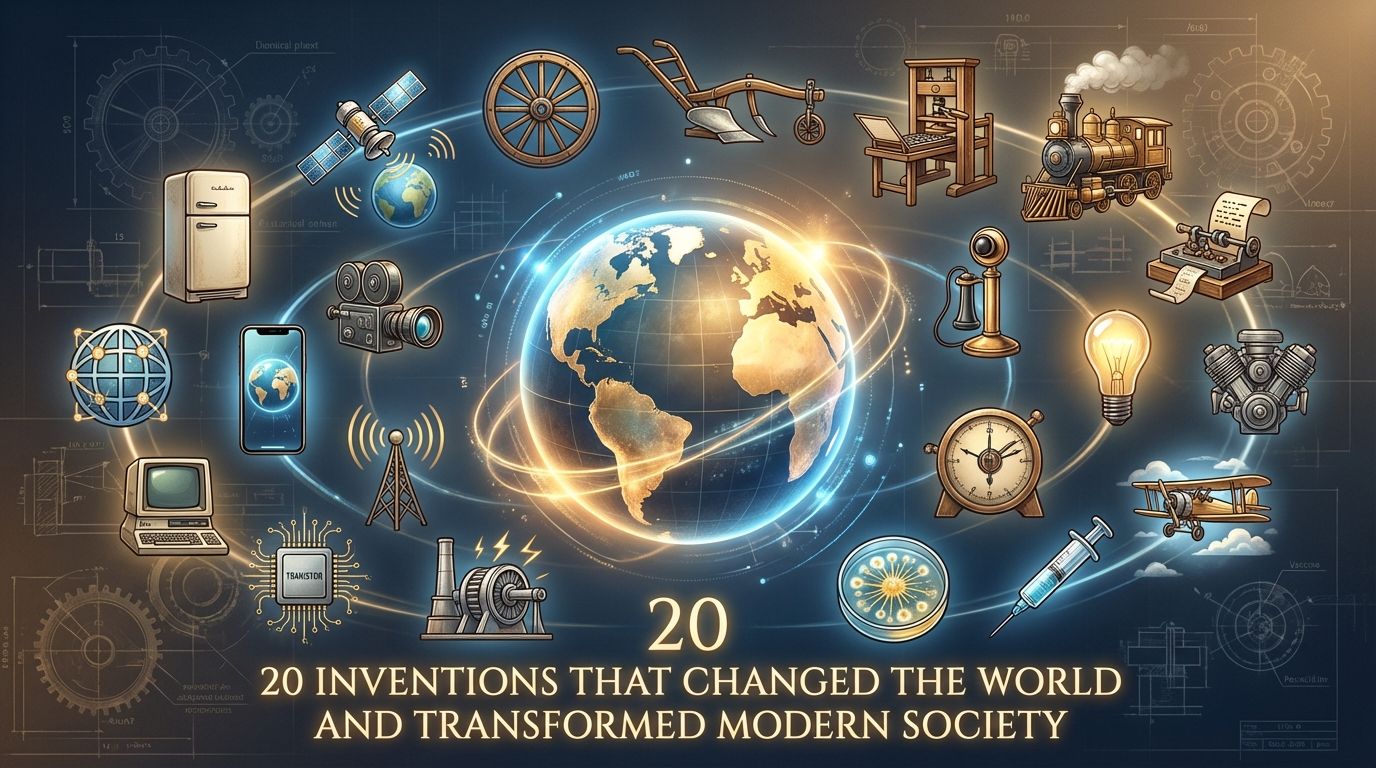
Inventions that changed the world have driven human progress from simple tools to complex systems that underpin modern life. This guide explores 20 of the most influential inventions, explaining their historical context, how they work at a basic level, and their measurable impact on society. Each entry includes a concise explanation and suggested further reading.
The 20 Inventions
1. The Wheel (c. 3500 BCE)
Historical context: Originating in ancient Mesopotamia, the wheel is among the earliest transformative technologies.
How it works (basic): A circular component that reduces friction and enables rolling motion, enabling carts, pottery wheels, and later machinery.
Impact: Enabled transport, trade expansion, mechanical devices, and laid the foundation for industrial machinery. The wheel’s principle underpins countless later inventions, from gears to turbines.
2. The Plow (Neolithic era)
Historical context: Agricultural societies adopted the plow to increase food production and support larger populations.
How it works (basic): A tool that turns or loosens soil to prepare seedbeds, improving aeration and nutrient distribution.
Impact: Boosted crop yields, supported urbanization, and enabled societal specialization and complex civilizations.
3. The Printing Press (c. 1440)
Historical context: Johannes Gutenberg’s movable-type printing press revolutionized information dissemination in Europe.
How it works (basic): Individual metal type pieces are arranged to form pages, inked, and pressed onto paper to reproduce texts quickly.
Impact: Democratized knowledge, accelerated the Reformation and Scientific Revolution, and enabled mass literacy. For more, see Britannica’s overview: Britannica – Printing Press.
4. The Steam Engine (18th century)
Historical context: Central to the Industrial Revolution, steam power transformed production and transportation.
How it works (basic): Heat converts water into steam, which expands and moves pistons or turbines to produce mechanical work.
Impact: Mechanized factories, powered locomotives and ships, and enabled mass industrialization. Read more: Britannica – Steam Engine.
5. The Telegraph (1830s–1840s)
Historical context: The telegraph introduced near-instant long-distance communication, shrinking informational distances.
How it works (basic): Electrical signals representing coded characters (e.g., Morse code) are transmitted over wires between stations.
Impact: Revolutionized commerce, diplomacy, and journalism by enabling fast communication across continents.
6. The Telephone (1876)
Historical context: Alexander Graham Bell and contemporaries made voice communication over wires practical.
How it works (basic): Converts sound waves into electrical signals at the transmitter and back into sound at the receiver.
Impact: Changed personal and business communication, creating new industries and shaping global networks.
7. The Light Bulb (late 19th century)
Historical context: Electric lighting replaced gas and candlelight, improving safety and extending productive hours.
How it works (basic): An electric current heats a filament or excites gases/LEDs to emit light.
Impact: Transformed urban life, work patterns, and infrastructure; accelerated electrification of cities.
8. Internal Combustion Engine (19th century)
Historical context: Powered automobiles, ships, and later aircraft, driving personal mobility and global logistics.
How it works (basic): Fuel-air mixtures combust inside cylinders to produce expanding gases that drive pistons and generate mechanical motion.
Impact: Spurred road networks, suburbanization, and modern supply chains; also drove energy consumption and environmental challenges.
9. The Airplane (1903)
Historical context: The Wright brothers achieved powered flight, unlocking rapid global travel.
How it works (basic): Engines provide thrust while wings generate lift through aerodynamic shapes and control surfaces.
Impact: Shrunk the world, enabling international trade, tourism, and rapid movement of people and goods.
10. Vaccination (1796 – Edward Jenner onward)
Historical context: Early inoculation practices evolved into modern vaccination, drastically reducing infectious disease mortality.
How it works (basic): Exposes the immune system to a harmless form of a pathogen or antigen to stimulate protective immunity.
Impact: Eradicated or controlled diseases (e.g., smallpox), improved life expectancy, and enabled global public health initiatives. See WHO resources: WHO – Vaccines.
11. Antibiotics (Penicillin, 1928)
Historical context: Alexander Fleming’s discovery of penicillin ushered in the antibiotic era, transforming medicine.
How it works (basic): Antibiotics inhibit or kill bacteria by targeting cell walls, protein synthesis, or metabolic pathways.
Impact: Dramatically reduced deaths from infections, enabling modern surgery and intensive care. Learn more: Britannica – Alexander Fleming.
12. The Electric Generator and Grid (late 19th – early 20th century)
Historical context: Centralized generation and distribution of electricity transformed industry and households.
How it works (basic): Mechanical energy (often from turbines) is converted into electrical energy via electromagnetic induction; grids distribute power broadly.
Impact: Enabled the electrification of cities and industries, powering countless subsequent inventions from appliances to computers.
13. The Radio (late 19th – early 20th century)
Historical context: Wireless electromagnetic communication enabled new forms of mass media and remote control.
How it works (basic): Information is encoded into electromagnetic waves and received by antennas tuned to specific frequencies.
Impact: Shaped news, entertainment, and emergency communication; precursor to modern wireless systems.
14. The Transistor (1947)
Historical context: The transistor replaced bulky vacuum tubes and enabled miniaturization of electronics.
How it works (basic): Semiconductor devices control electrical signals using p-n junctions to amplify or switch currents.
Impact: Foundation for modern electronics, integrated circuits, and the digital revolution. See IEEE historical notes: IEEE – Transistor History.
15. The Computer (mid-20th century)
Historical context: From mechanical calculators to programmable electronic computers, machines transformed data processing.
How it works (basic): Perform arithmetic and logical operations under program control using processors, memory, and I/O systems.
Impact: Revolutionized science, business, communication, and entertainment; enabled the information age and modern software industries.
16. The Internet (late 20th century)
Historical context: Evolving from ARPANET, the internet created a global network for data exchange.
How it works (basic): Packets of data routed across interconnected networks using standardized protocols (TCP/IP).
Impact: Transformed communication, commerce, education, and media. For background, consult the Internet Society: Internet Society.
17. The Camera and Photography (early 19th century)
Historical context: The ability to capture images changed journalism, art, and memory preservation.
How it works (basic): Lenses focus light onto a photosensitive surface (film or sensor) to record images.
Impact: Democratized visual storytelling, enabled scientific observation, and shifted cultural records and media production.
18. Refrigeration (19th–20th century)
Historical context: Refrigeration changed food storage, transport, and medical logistics.
How it works (basic): Uses cycles of compression and evaporation of refrigerants to remove heat and maintain low temperatures.
Impact: Reduced foodborne illness, enabled global food supply chains, and preserved medicines and vaccines.
19. GPS (Global Positioning System, late 20th century)
Historical context: Satellite navigation systems provide precise location and timing data worldwide.
How it works (basic): Receivers calculate position by measuring time delays from multiple satellites broadcasting synchronized signals.
Impact: Revolutionized navigation, logistics, emergency response, and location-based services.
20. The Smartphone (21st century)
Historical context: Convergence of computing, telephony, and sensors into handheld devices transformed personal connectivity.
How it works (basic): Integrates a powerful processor, cellular and wireless radios, sensors, and a touchscreen interface to run applications and connect to the internet.
Impact: Rewired daily life—communication, commerce, learning, and entertainment—making information and services available instantly. The smartphone is a visible culmination of many earlier inventions that changed the world.
Common Themes and Wider Impacts
- Scalability: Many inventions became transformative when scalable manufacturing or infrastructure (like grids and networks) allowed mass adoption.
- Interdependence: Innovations often rely on previous technologies (e.g., the internet relies on semiconductors and electricity).
- Social change: Inventions reshape labor, governance, health, and cultural norms—frequently producing both benefits and challenges.
Further Reading and Sources
Reliable external sources used for context and additional details include: Encyclopaedia Britannica, the World Health Organization, and the Internet Society.
Conclusion
The 20 inventions highlighted here demonstrate how human ingenuity—applied across centuries and contexts—has driven sweeping transformations. From the ancient wheel to the modern smartphone, each represents a step in a network of progress. Understanding these inventions that changed the world helps students, educators, and curious readers appreciate the technical principles and social consequences that continue to shape our future.