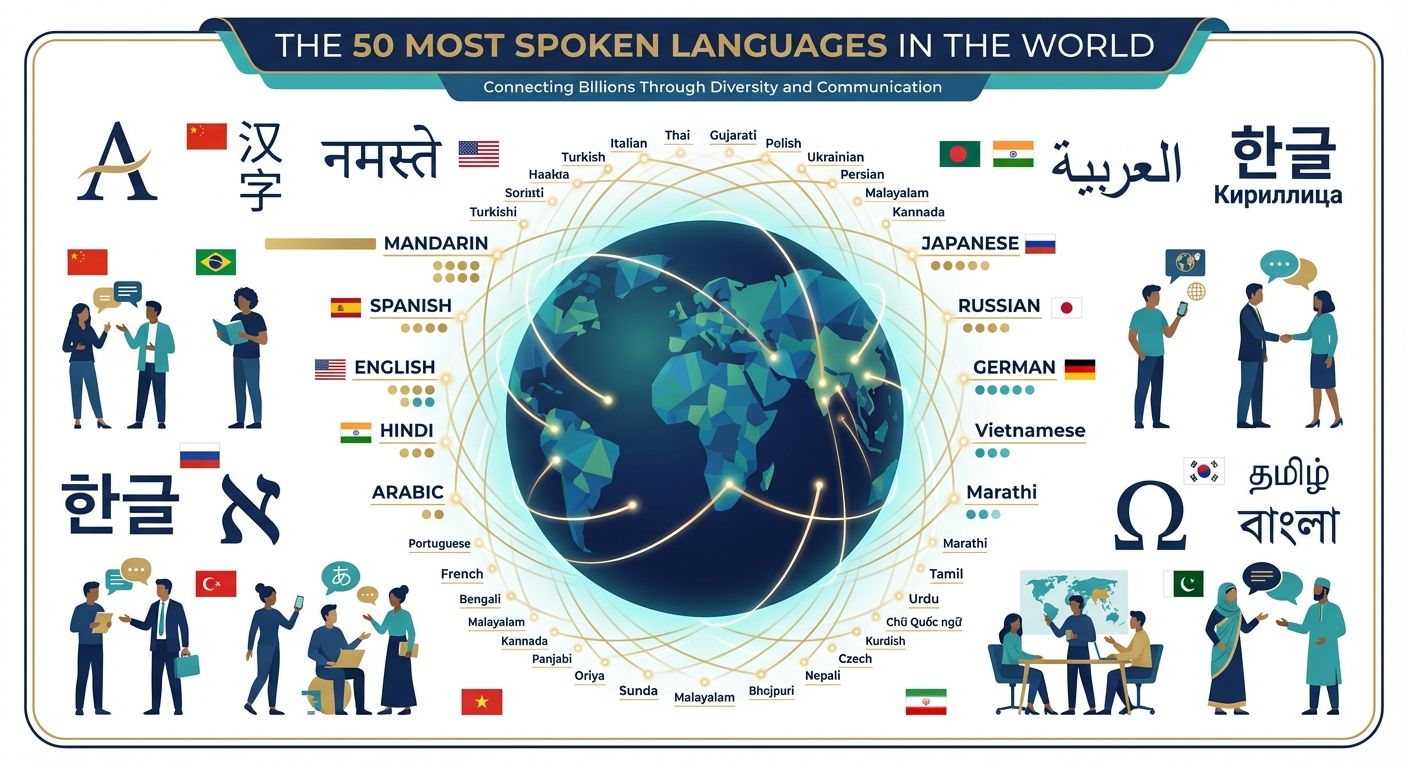
Spoken languages are the threads that connect cultures, economies and identities across the globe. This guide presents the top 50 most spoken languages, offering concise data on number of speakers, main regions, cultural importance and interesting curiosities to help readers—from linguistics enthusiasts to travelers—understand global linguistic dynamics.
Why this list matters
Knowing which languages are most widely spoken helps in planning travel, education, business, and cultural exchange. Beyond raw numbers, the distribution of languages reveals historical migration, colonial legacies, and contemporary soft power. This guide balances quantitative estimates with qualitative context.
Methodology and sources
Estimates combine native and second-language speakers using multiple reputable sources, including Ethnologue, World Atlas and up-to-date linguistic surveys. Numbers are rounded and presented as approximations because census methods vary by country. For deeper research, consult the linked external sources and national statistics offices.
The Top 50 Spoken Languages (concise profiles)
Each entry includes: language, approximate global speaker count, main regions, cultural/economic importance and a short curiosity.
1–10
- English — ~1.5 billion speakers. Regions: Global (US, UK, Canada, Australia, India, Nigeria, etc.). Importance: Global lingua franca for business, science and internet. Curiosity: English evolved with massive vocabulary borrowing from French and Latin.
- Mandarin Chinese — ~1.1 billion. Regions: China, Taiwan, Singapore, diaspora. Importance: Largest native speaker base and major economic influence. Curiosity: Several mutually unintelligible varieties exist, but Standard Mandarin is based on Beijing dialect.
- Hindi — ~600–700 million. Regions: India, diaspora. Importance: One of India’s official languages, central to Bollywood and regional media. Curiosity: Hindi and Urdu share grammar and much vocabulary but use different scripts.
- Spanish — ~550–600 million. Regions: Spain, Latin America, US. Importance: Major global language for culture, media and diaspora communities. Curiosity: Spanish has many regional varieties; Castilian Spanish includes the distinctive “th” sound (ceceo).
- French — ~280–300 million. Regions: France, Canada, parts of Africa, Caribbean. Importance: Diplomacy, international organizations (UN, EU). Curiosity: French remains an official language in many African countries due to colonial history.
- Modern Standard Arabic — ~274 million. Regions: Middle East, North Africa. Importance: Religious, literary and media lingua franca across Arabic-speaking countries. Curiosity: Colloquial Arabic dialects can be mutually unintelligible.
- Bengali (Bangla) — ~265 million. Regions: Bangladesh, West Bengal (India). Importance: Major literary and cultural language in South Asia. Curiosity: Bengali has a rich poetic tradition and its own script (Bangla script).
- Portuguese — ~260 million. Regions: Portugal, Brazil, parts of Africa (Angola, Mozambique). Importance: Brazil’s size makes Portuguese influential in Latin America and Lusophone Africa. Curiosity: Brazilian Portuguese differs significantly in pronunciation and vocabulary from European Portuguese.
- Russian — ~258 million. Regions: Russia, Eastern Europe, Central Asia. Importance: Key regional lingua franca, scientific literature, and media. Curiosity: Russian uses Cyrillic script and has complex aspectual verb system.
- Urdu — ~170–230 million. Regions: Pakistan, India, diaspora. Importance: National language of Pakistan and major literary tradition (poetry). Curiosity: Shares much vocabulary with Hindi but written in Perso-Arabic script.
11–20
- Indonesian (Bahasa Indonesia) — ~200 million. Regions: Indonesia, Malay-speaking areas. Importance: National language of the world’s fourth most populous country. Curiosity: A standardized register of Malay, it adopted many loanwords from Dutch, Sanskrit and Arabic.
- German — ~135–150 million. Regions: Germany, Austria, Switzerland. Importance: Europe’s largest economy; strong presence in science and engineering. Curiosity: German compounds allow very long words used for precise meanings.
- Japanese — ~125–130 million. Regions: Japan, diaspora. Importance: Major cultural exporter (manga, anime, tech). Curiosity: Japanese has three scripts used together: Kanji, Hiragana and Katakana.
- Swahili — ~98–110 million. Regions: East Africa (Kenya, Tanzania, Uganda). Importance: Regional lingua franca and medium for pan-African communication. Curiosity: Swahili’s vocabulary includes many Arabic loanwords.
- Marathi — ~95–100 million. Regions: Maharashtra (India). Importance: Vibrant regional literature and cinema. Curiosity: Uses Devanagari script, like Hindi, but has distinct vocabulary and phonology.
- Telugu — ~95 million. Regions: Andhra Pradesh, Telangana (India). Importance: Major Dravidian language with rich classical literature. Curiosity: Telugu script is round and ornate, often called “the Italian of the East” for its script aesthetics.
- Turkish — ~88–90 million. Regions: Turkey, Cyprus, parts of Europe and Central Asia. Importance: Bridge language between Europe and West Asia; strong media presence. Curiosity: Turkish underwent a Latin-alphabet reform in the 1920s under Atatürk.
- Korean — ~82–85 million. Regions: South Korea, North Korea, diaspora. Importance: Global cultural impact via K-pop and K-drama. Curiosity: Korean script Hangul is phonemic and considered one of the most scientific writing systems.
- Vietnamese — ~85 million. Regions: Vietnam, diaspora. Importance: National language with growing economic relevance. Curiosity: Uses Latin alphabet with diacritics due to Portuguese and French missionary influence.
- Italian — ~67–70 million. Regions: Italy, parts of Switzerland. Importance: Cultural weight in art, music, fashion and cuisine. Curiosity: Modern Italian evolved from Tuscan dialects and literature of Dante.
21–30
- Thai — ~69 million. Regions: Thailand. Importance: Central to culture, religion (Buddhism), and tourism. Curiosity: Thai is tonal and uses its own script derived from Khmer.
- Gujarati — ~56–60 million. Regions: Gujarat (India), diaspora. Importance: Strong commercial and diasporic networks. Curiosity: Gujarati script is an abugida related to Devanagari but without the headline stroke.
- Kannada — ~55–60 million. Regions: Karnataka (India). Importance: Classical literature and emerging tech hub. Curiosity: Kannada has one of the oldest literary traditions among Dravidian languages.
- Persian (Farsi) — ~62 million. Regions: Iran, Afghanistan (Dari), Tajikistan (Tajik). Importance: Historical language of literature, poetry and administration in Persia and beyond. Curiosity: Persian influenced many South Asian languages and vice versa.
- Polish — ~45–50 million. Regions: Poland, diaspora. Importance: Central European language with growing economic role in the EU. Curiosity: Polish orthography uses diacritics and complex consonant clusters.
- Ukrainian — ~40–45 million. Regions: Ukraine, diaspora. Importance: National identity and literature; rising global attention. Curiosity: Uses Cyrillic script but is distinct from Russian in vocabulary and phonology.
- Romanian — ~24–28 million. Regions: Romania, Moldova. Importance: Only major Romance language in Eastern Europe. Curiosity: Romanian preserves Latin-based structure with Slavic and Balkan influences.
- Oromo — ~35–40 million. Regions: Ethiopia, Kenya. Importance: Major Cushitic language with growing media and political role. Curiosity: Uses Latin script in modern orthography but previously used Ge’ez and Arabic scripts.
- Igbo — ~44 million. Regions: Nigeria, diaspora. Importance: One of Nigeria’s main languages with rich oral literature. Curiosity: Igbo has many dialects and a vibrant traditional music culture.
- Yoruba — ~40–45 million. Regions: Nigeria, Benin, Togo, diaspora. Importance: Cultural and religious influence in West Africa and the diaspora. Curiosity: Tonal language with strong drumming-language traditions.
31–40
- Malayalam — ~38–40 million. Regions: Kerala (India). Importance: Literary tradition and film industry. Curiosity: Malayalam script is derived from Grantha and has many vowel symbols.
- Sundanese — ~39 million. Regions: West Java (Indonesia). Importance: Strong regional identity and media. Curiosity: Sundanese retains pre-Islamic cultural elements in literature and performance.
- Sindhi — ~30–32 million. Regions: Pakistan, India. Importance: Cultural and commercial networking in the Indus region. Curiosity: Written in multiple scripts, including Arabic-based and Devanagari variants.
- Kurdish — ~30–35 million. Regions: Turkey, Iran, Iraq, Syria. Importance: Language of a large stateless nation with significant cultural mobilization. Curiosity: Several dialects and scripts (Latin, Arabic, Cyrillic) are used regionally.
- Nepali — ~17–24 million. Regions: Nepal, India. Importance: National language of Nepal and lingua franca in parts of the Himalayas. Curiosity: Nepali uses Devanagari and shares features with Hindi and other Indo-Aryan languages.
- Greek — ~13–15 million. Regions: Greece, Cyprus. Importance: Foundation of Western literature, science and vocabulary in many European languages. Curiosity: Modern Greek continues a documented history spanning millennia.
- Hindi-Urdu variations (additional regional counts) — noted in earlier entries; included to highlight shared linguistic base and cultural influence across South Asia.
- Zulu — ~27–30 million. Regions: South Africa. Importance: One of South Africa’s official languages with strong cultural expression. Curiosity: Zulu features click sounds borrowed from Khoisan languages.
- Bulgarian — ~7–9 million. Regions: Bulgaria. Importance: Slavic language with historical role in Orthodox Christianity and literature. Curiosity: Uses Cyrillic script, which was created in the First Bulgarian Empire.
- Hausa — ~50 million. Regions: West Africa (Nigeria, Niger). Importance: Widely used trade language across the Sahel; rich radio and media presence. Curiosity: Often written in Latin and an older Arabic-based script called Ajami.
41–50
- Afrikaans — ~16–18 million. Regions: South Africa, Namibia. Importance: Derives from Dutch; significant in Southern Africa’s media and literature. Curiosity: One of the youngest Germanic languages with simplified grammar compared to Dutch.
- Amharic — ~25–30 million. Regions: Ethiopia. Importance: Ethiopia’s working language with historical Christian literature. Curiosity: Uses Ge’ez script, an ancient writing system still in use.
- Fula (Fulani) — ~25–30 million. Regions: West and Central Africa. Importance: Pastoralist communities and trade networks. Curiosity: Highly dispersed with many regional varieties.
- Romanian — included earlier; duplication avoided in counts but note regional significance in Moldova.
- Punjabi — ~125–130 million. Regions: Pakistan, India. Importance: Large regional language with rich Sufi and folk traditions. Curiosity: Written in Gurmukhi script in India and Shahmukhi (Perso-Arabic) in Pakistan.
- Burmese — ~33 million. Regions: Myanmar. Importance: National language and scripture in Theravada Buddhism. Curiosity: Uses its own Brahmic-derived script with circular shapes.
- Haitian Creole — ~12 million. Regions: Haiti, diaspora. Importance: National language of Haiti; blend of French and West African languages. Curiosity: Gained official status alongside French and supports vibrant oral culture.
- Cebuano — ~20 million. Regions: Philippines (Visayas). Importance: Major regional language with active media. Curiosity: One of several major Philippine languages alongside Tagalog/Filipino.
- Tagalog (Filipino) — ~50 million. Regions: Philippines, diaspora. Importance: Basis for the national language Filipino and central in media and education. Curiosity: Uses Latin script with many Spanish loanwords.
- Other notable languages (brief list): Maithili, Kannada (already listed earlier), Assamese, Sinhalese (~16 million), Khmer (~16 million), and regional languages that make up global diversity.
Global trends and takeaways
- Language concentration: A small set of languages (English, Mandarin, Spanish, Hindi) cover a huge share of global communication.
- Regional lingua francas: Swahili, Arabic, Russian and Hausa serve broad regional roles beyond their native speaker base.
- Writing systems matter: Scripts (Latin, Cyrillic, Arabic, Devanagari, Han characters) reflect historical influence and literacy policies.
- Multilingualism: Most speakers are bilingual or multilingual—knowing regional languages is essential for local participation.
Practical implications for learners and educators
Choosing which spoken languages to study depends on goals:
- Career/international business: English, Mandarin, Spanish, Arabic, French.
- Regional travel: Learn the regional lingua franca (e.g., Swahili in East Africa, Bahasa Indonesia in Indonesia).
- Cultural immersion: Choose languages with rich literary or media output (Japanese, Korean, French, Russian, Arabic).
Tips for learning based on language reach
- Start with high-frequency vocabulary and cultural phrases used by native speakers.
- Use media (films, music, podcasts) from target-language countries to build comprehension and cultural context.
- Combine formal study with conversation practice — language partners and tutors extend classroom gains.
Curiosities and cultural notes
- Diglossia: Arabic has significant differences between spoken dialects and Modern Standard Arabic used in formal contexts.
- Script diversity: Languages such as Japanese, Korean, Russian, Greek and Arabic use distinct scripts; Latin script remains widespread due to colonial and global influence.
- Language families: Indo-European (English, Spanish, Russian), Sino-Tibetan (Mandarin), Afro-Asiatic (Arabic), Austronesian (Malay, Indonesian), Dravidian (Tamil, Telugu) and Niger-Congo (Swahili, Yoruba) are among major families represented.
Sources and further reading
Primary references include Ethnologue (ethnologue.com), UNESCO language reports, national censuses and peer-reviewed linguistic research. For an accessible overview consult Wikipedia’s compiled list.
Final thoughts
This list of the top 50 spoken languages offers a snapshot of global linguistic influence. Numbers shift with demographics, migration and changing language policies—so use this guide as a starting point for deeper exploration. Languages are living systems; each one carries unique knowledge, identity and creativity that shape global culture.